
Don’t Waste Your Pain - Ruth 1


Bob Gross’ NBA team really needed him. Their season was on the brink, and if they had any hopes of making the playoffs then Bob would need to suit up and show up big time. There was just one problem- Bob had a badly injured ankle that was giving him a tremendous amount of pain. No problem. Not long before tipoff the doctors injected a strong painkiller into three places in Bob’s foot, totally numbing the pain. The game begins and a few moments later, Bob goes for a rebound, lands, and everyone on the court hears a loud snap; Bob however didn’t feel a thing. He tries to run down court and ultimately crumples to the ground. This was not only his last play in the game, but tragically it became the last play of his NBA career. Bob’s inability to feel pain ruined him.
It really is counter-intuitive, but pain- our deepest hurts- is often times God’s greatest gift to us. Pain is far more helpful than harmful. This is a discovery that the world’s foremost scholar on pain, Dr. Paul Brand points out when he says, “Pain is often seen as the great inhibitor, keeping us from happiness. But I see it as a giver of freedom.” The great writer and intellectual, C.S. Lewis continues Dr. Brand’s train of thought, but connecting the assets of pain to God when he writes, “God whispers to us in our pleasures, speaks in our conscience, but shouts in our pains. [Pain] is His megaphone to rouse a deaf world”- C.S. Lewis, The Problem of Pain. Both Dr. Paul Brand and C.S. Lewis posture pain as a gift, a wonderful asset, and implore us to not waste our pain.
Why Should I Listen?
If there’s one word that sums up Ruth 1, it’s pain. Our story today is all about pain. I mean just look at the intense and prolonged season of pain Naomi goes through as she seemingly loses everything. She suffers a famine that causes her and her family to uproot from their home in Bethlehem and venture out as immigrants into a foreign country. Not only that but there’s good reason to believe that she has a disabled child. One of her sons name is Mahlon. Now in antiquity what you named your child was major; it spoke to some aspect of their character. Mahlon’s name means weak or sickly. In all likelihood she either named him this originally because this is how he came out of the womb, or she changed his name to this because of some debilitating sickness. In either event Naomi has had to endure a suffering child. See the pain? But it gets worse. Her husband dies. Her two children die. She loses a daughter in law. And then in verse 21 she sums it up by saying she went out full and has now come back to Bethlehem empty.
Oh, and one more thing, as if this wasn’t enough. The narrator of the story tells us that she was an Ephrathite. Now this is an important word that speaks of her status or class. Ephrathites were the upper class of Israel. It’s a statement of her wealth. It’s like saying Naomi was a Vanderbilt, or a Kennedy or a Zuckerburg. It’s like saying she lives up in the hills of Portillo Valley.
Get the picture? This wealthy woman goes through a horrendous season of pain. I think the narrator is pointing out something we all know and that is pain is universal. Pain does not discriminate or play favorites. Pain stretches its tentacles from the projects to the gated community. All of us in this room have experienced pain. Some of us know the pain of a broken home where daddy walked out. Others of us know the pain of abuse. Still others of us know the pain of a failed marriage. Many of us know the pain of death, as we’ve had to say see you later to loved ones. Still others know the pain of failure- at school, on the job, making poor decisions. Others know the pain of addiction. Oh yes, pain is universal.
So the question is what do we do when pain comes knocking? When God comes shouting to us through our pain what are we to do? How do we steward well the gift of pain? Our text shows us three things about pain we must see if we are going to use it for the gift that it is, helping to make us better and not bitter.
PAIN IS PURPOSEFUL- RUTH 1:1
The first thing we should see about pain is that pain has a purpose. Look with me at verse one. Here is Naomi going through the pain of a famine in Bethlehem, and what does she do? She packs her stuff up and moves. She gets to Moab and there’s more pain as she watches her husband and children die. What does she do? She packs up yet again and moves back to Bethlehem. And what does she do when she gets back to Bethlehem? Look at verse 19- she blames God. She’s upset with God. Now, here’s the disconnect we have with Naomi: We know the whole story and she doesn’t. See what we want to say to Naomi is hold on, girlfriend. God is setting you up for a major move and miracle in your life. Hold on. We see the big picture. She doesn’t, and since she can’t see the big picture she starts to blame God.
Isn’t this our reflex reaction when pain comes to our lives- to get down on and blame God? Why did you take my mother from me? God’s not good, if he was he wouldn’t have allowed me to go through this. This always happens because the problem with life is fundamentally the problem of perspective. And what we don’t realize is that we are just in one chapter of our lives, but God is writing a whole book! See, that’s why the Bible rarely deals with the why of pain and suffering, and instead asks of pain, to what end? What is the purpose? In a stunning passage to the Corinthians- a community in a lot of pain- Paul says these words, “But it hurt you only for a little while. Now I am glad I sent it, not because it hurt you, but because the pain turned you to God. It was a good kind of sorrow you felt, the kind of sorrow God wants his people to have”- 2 Corinthians 7:8-9, Living Bible. See it? Paul says your pain was not frivolous; it had a purpose! And that purpose was to turn you to God. This is important, because when pain comes knocking I most always remind myself there is a purpose to the pain!
Mary Verghese was a promising young doctor whose future was bright. All that changed one day when she got into a car with a young man and ended up in an accident that left her lower body paralyzed, and her face deeply scarred. In that first season of pain the doctors tried everything to help her, but to no avail. Finally, after some encouragement and a lot of hard work she returned to being a doctor, becoming India’s first wheelchair doctor. She practiced medicine in a colony of lepers, and it is said that when she wheeled into examine these lepers all of their sense of despair and self-pity went away. Her face was like theirs- deeply scarred. God used her to bring hope to the lowest of the low, because she could empathize with their plight. And her empathy was birthed out of suffering. Out of her pain came her purpose.
It has been said if you want to find your purpose take inventory of your pain! Oh yes, I’ve found that to be true in my own life. I am often asked how I came to be so passionate about the multiethnic church and seeing races come together. I always respond by saying that purpose was birthed out of a deep pain, the pain of being called a nigger in Bible College. I know many social workers who give their lives to help the abused and marginalized because in their story there was abuse and neglect. You want to know your purpose? Take inventory of your pain. Don’t waste your pain. Your pain has a purpose!
PAIN IS TRANSFORMATIVE- RUTH 1:20
So Naomi returns home to Bethlehem after a prolonged season of pain, and the Bible says the whole town is stirred. I think it’s because they are both shocked Naomi, their long departed friend is back, and when they see her they are stirred because they see a drastic change in her countenance. The text speaks to this. See, her name Naomi, means pleasant, but now she says don’t call me Naomi but Mara. Mara means bitter. Names were important back then because they spoke to who you were. Naomi has gone from Naomi to Mara, from pleasant to bitter. Isn’t that a fundamental property of pain? Pain changes us. It will make us either better or bitter. Pain can be an asset or a liability, it’s all in how we steward it. Pain changes us.
This is all throughout the Bible. There’s a moving story in Genesis where we are introduced to a young man named Joseph. He’s full of arrogance and pride as he tells his brothers how they will bow down to him and serve him. Fast forward to the end of the story and we see a completely different man who is compassionate and full of empathy for his brothers. He’s moved to tears when he sees them, and how he relates to them is out of a posture of humility. Well what changed him? Pain, and his decision to allow his pain to make him better and not bitter. Don’t you see, the question is not will pain come, but how will we steward it when it does come?
Story is told of a young man who made it his business to stump the local village wise man. This wise man had answers to everything and this young man was going to get him. His plan seemed full proof: Get a bird, hold it in his hand, and ask the wise man if the bird was alive or dead. If the wise man said it was dead he’d open his hands and show him it was alive. If the wise man said it was alive, he’d simply crush the bird in his hand. Excited he stood before the wise man and said, “Is this bird dead or alive?” The wise man smiled and said, “Neither. The bird is in your hands”. And so it is with pain. Pain is in our hands. How will we steward it?
Okay. So you’re here, and it’s happened. Fatherlessness is in your hands. How will you steward the pain of an absent dad or mom? My mother once told me that she made up her mind to be a great mom because she saw the pain of her mom not doing what she should. So she decided to use that pain to make her a great mom. The pain of cancer or sickness is in your hand. How will you steward that for the glory of God? The pain of failure is in your hand? Will you decide to get better or bitter?
PAIN IS TEMPORARY- RUTH 1:22
Finally, Naomi and Ruth go to Bethlehem after enduring years of pain. And then our story ends with a funny statement in verse 22, will you look at it with me. The narrator points out the time in which they return home- it was the time of barley harvest. This is weird. Why would he say that? Barley harvest took place around April or May. It was one of the most celebrated times of the year on the Jewish calendar. It was a season of the year marked by intense rejoicing, singing and dancing. The women would be jumping up and down and singing. You could hear the celebration in Bethlehem from miles away. Don’t you see what Naomi and Ruth are walking into is a complete 180 from what they have just gone through? Don’t you see that in literary terms this is foreshadowing? What the author is telling us is that Ruth and Naomi are literally stepping out of one season of pain, into a new season of rejoicing! Pain is temporary.
Don’t ever forget that pain is a season. As the old Negro spiritual says, “Trouble don’t last always”. This is what David found out. David, Ruth’s great-grandson, went through intense pain in his life. Was on the run from a king who was trying to kill him. He lost a baby, and had his best friend and son turn against him. And yet David says in Psalm 30 that weeping may endure for a night, but joy comes in the morning! Pain is temporary!
My little wife Korie has given birth to three big head boys, all natural. Let me repeat that phrase, ALL NATURAL! I was there to see her writhing in agony, feeling the painful fullness of every contraction and push. Oh yes, I have a ripped shirt to testify of my presence. I was also there to hear her speak in tongues. And yet, after our first two kids, and all that pain, she wanted to do it again. Why? Well, you know why. First, she knew that pain was temporary. Those contractions and labor pains were but for a season. But secondly, and more importantly, she wanted to do it again because of what was on the other side- the joy of holding a child. When she saw what was on the other side, it allowed her to go through the pain, stewarding it well!
Oh, is this not Jesus! Jesus endured the pain of the cross, where he was beaten with a whip, crowned with a crown of thorns bloodying his skull, had his beard plucked out, nails in his hands and feet, and a spear run through his side. So why Jesus did you do it? The writer of Hebrews tells us that he did it because of the joy that was set before him! What was that joy? You and I, coming to faith in Jesus Christ! Spiritual birth is why he went through the pain and agony, so that you and I could experience the barley harvest of eternal life with him in heaven where there will be no tears.
GOSPEL CONCLUSION
Don’t you see? This text shows us a valuable lesson when it comes to having a relationship with God, and that is God often uses pain in our lives to move us into our greatest purpose, and that is a relationship with him. Ruth gets saved in our text because of this. After losing her own husband and enduring pain, Ruth says these words in verses 16-17. What’s happening here? She has come to faith in God. What brought her to faith? Pain and suffering.
Here’s my concern for us in Silicon Valley: The reason this is one of the most secular, Godless places on earth is because this is one of the most affluent places on earth. I’m not saying there’s no pain here, but what the affluent do is they see pain and do everything they can to get rid of it, or turn against God. One of the most helpful things God could ever do to us is to allow pain in our lives so that we turn to him. Won’t you come to him!

Nice Guys Finish First Psalm 1


Growing up I used to collect baseball cards—remember those? I can still to this day see myself opening up one of those Fleer packs of baseball cards with the stick of pink gum, and popping it in my mouth. I’d immediately start scrolling through the cards to find any special players—you know the one’s with the highest batting averages, most homeruns and All Star appearances—these were the most valuable. When I’d find one of these special successful players, I’d pull them out and put them in a designated plastic sleeve in one of my baseball card notebooks. Those notebooks filled with special players was my prized possession (until my mother threw it out thinking it was worthless while I was out at college…no I’m not bitter). I spent hour after hour flipping through those notebooks with the special players, idolizing them. Looking back, while I’d do well emulating their performance on the field, I wouldn’t want to mimic many of their characters. For many, these special ball players were great performers, but not the best people.
Creating the Need
You know the problem with our society is we tend to place a higher price tag on performance than we do integrity. We live in a world where people are enamored with achievements, accolades and accomplishments, yet not as impressed with character. As the old saying goes, “Nice guys finish last.” Our text—Psalm 1—says something vastly different, though. It actually shows us that “Nice Guys Finish First.” This Psalm presents us with a man worth emulating—a man who’s full of character. Brothers, we’d do well to cut and paste into our lives the attributes of this righteous man.
But why? Why should we be like the righteous man in our text? Psalm 1 is not a really complicated one to figure out. Just reading through the Psalm, you can see there are two kinds of men in our text—the righteous and the wicked. Notice how the Psalmist describes the wicked man—he says they are like chaff. Now he’s using an agricultural analogy to describe the wicked. During the winnowing process, the farmer had one goal—to separate the chaff from the wheat. He would take his winnowing fork and toss the grain into the air over and over. In that process, the heavier kernel of grain would separate from the lighter chaff and fall to the ground but, because the chaff was so light, it would fly off into the air. It didn’t have enough substance or weight to fall to the ground; it just flew off. This is interesting in how the Psalmist describes the wicked man—not much substance. Sure this brother maybe heavy when it comes to his finances, his looks and his possessions, but when it comes to things that really matter in life like character and integrity, he’s like chaff—light, no substance or weightiness.
On the other hand is the righteous, and notice how the Psalmist describes this brother—he’s a tree. I love this imagery, and we’ll unpack it more in a few minutes, but trees are rooted, weighty masses that give life to those around them. Trees don’t just disappear like chaff. Trees aren’t here one moment and gone the next. There’s a weight to them, and they give life. That’s the righteous man. He’s weighty when it comes to his character. He gives life. Brothers we need to be like trees and not like chaff.
But Why Be Righteous?
But I still haven’t answered the question of why. Why should we men be like the righteous man in our text? The Psalmist answers this question with the very first word in our text—blessed. Why should I give myself to being like the righteous man? Because if I do, I will experience the blessed life. But what does this mean? The word blessed simply means happy, and there I’ve just lost many of you who grew up in the church, because you’ve been taught all your life that to be happy is bad. But this simply is not true. God is for our happiness, He just wants us to make sure that our happiness has the right source.
Psalm 1 has been described by many scholars as being a beatitude. Now if you’re not a Christian, you still probably have heard of this word beatitude because there’s a series of these in the most famous sermon ever given—the Sermon on the Mount. I believe Jesus had in his mind Psalm 1 as He gives the beatitudes. He says: “Blessed are the poor in spirit. Blessed are those who mourn. Blessed are the meek. Blessed are those who hunger and thirst after righteousness. Blessed are the merciful. Blessed are the pure in heart. Blessed are the peacemakers. Blessed are those who are persecuted for righteousness sake.” Or to say it another way, Jesus is saying: HAPPY! HAPPY! HAPPY! Shocking I know! But please notice that none of these happy statements have to do with money, possessions or even health. Jesus doesn’t say blessed is the person who drives an Audi. Or blessed is the person who has a lot of money. Instead, most of these beatitudes end with something that points to the kingdom of God. In other words, the blessed person is the person who is living in the center of God’s will for their life, where God is their source of happiness and nothing else.
See the biggest question in life is not, “What Am I Here For,” but “Who Am I Here For?” The righteous man has figured that out. What makes him righteous is his life has answered the “who am I here for” question, by saying “it’s God,” and he now lives in total surrender to God. And when the righteous person lives in total surrender to God, he now finds himself living the blessed or happy life. He’s happy because he walks with God and knows God is with him! To be blessed is to know I’m in the sweet spot of God’s will!
Several years ago, a buddy of mine gotta call that his wife’s water just broke and she was in labor with their first child. He zipped home, picked her up and sped down the freeway to the hospital. On his way, he saw flashing lights behind him—it was a cop. Pulling over, he immediately got his license and registration and gave it to the cop and said he was sorry but his wife was in labor and that’s why he was speeding. The cop handed the items back to him and said I don’t need those, let’s get you to the hospital. The cop now turns his lights on, calls another cop and escorts my buddy and his bride to the hospital as they were speeding. But this time, as they were speeding, my buddy wasn’t stressed or worried he was breaking the law, or was going to get pulled over. Why? Because he had the blessing of the authorities. He knew he was in the center of their will. And so it is with the righteous man. When you are walking with God, you will live the blessed and happy life, because you know God is with you. BLESSED IS THE MAN! Oh brothers, we need to be righteous men!
THE RIGHT COMPANIONS—PSALM 1:1
We’ve answered the question as to why we should be righteous—when we do we will live the blessed life. Now let’s close with exactly how do I get to experience this blessed life? Brothers, there are only two decisions this man makes that leads to him being righteous and experiencing the blessed life. If we make these two decisions, we will be experiencing the blessed life.The first decision he makes is to have the right companions. Look at verse 1. Now I know what you’re thinking: “Wait a minute pastor. Are you saying I can’t have non-Christian friends, or have my non-Christian neighbors over for a meal?” No, not at all. Notice the words wicked, sinners and scoffers are in the plural, which speaks more to the environment, and not to the individual. Also, the words walk, stand and sit speak of someone who is joining themselves in these bad environments. What the Psalmist is warning against is hanging out by way of life in sinful environments, and the hazardous effects that can have on your life.
When I first started driving, I remember being out one night with some friends. We had just finished dinner and were going over to one of their homes, and since I didn’t know how to get there, I was following them. I do recall they were moving pretty fast, and I was having a hard time keeping up. Finally, they get pulled over by the police, and without even thinking about it, I pull over too.
The cop says to me, “Can I help you?”
I tell him, “No I’m good, I was just following my friends.”
“Oh you were,” he said. “So that means you were speeding, too. Sit tight, your ticket is coming.” I got a ticket that night for following people who were making bad choices.
Writing to the Corinthians, the apostle Paul says, “Do not be deceived: ‘Bad company ruins good morals’”—I Corinthians 15:33. Brothers, if we are going to be righteous men, we have to start by taking inventory of our companions, and the environments we hang out in. Now on the one hand, admittedly, if I were preaching this upstairs to our youth, I’d take time right now to talk a lot about peer pressure, because that’s a real thing when you’re in high school or college. But I’m talking to mainly adults here who I’m guessing that’s not as big of a deal. So how can we apply this?
As a general rule of thumb, men, if you want to apply Psalm 1 to your life, take inventory of your weaknesses, and weed out anyone in your life who facilitates those weaknesses. If you struggle with alcohol, don’t run with people who encourage you to drink. If drug addiction is a part of your story, don’t run with people who would encourage you to do drugs. If sexual sin is your struggle, then don’t do life with other brothers who do not hold biblical convictions when it comes to sex. Nor should you be in a relationship with anyone who would encourage you to compromise your standards in the area of sex.
Brothers, don’t just see the wicked, sinners or scoffers as other men, also see some women in this crowd who exist to bring you down by encouraging marriage infidelity and sexual promiscuity. As I pray for my sons almost daily, “God frustrate the plans of the Jezebels.” The righteous man avoids the seductive woman. This is a point PROVERBS 5:3–15 makes. Listen as I read…
The Right Companions
One more thing before I move to my last point. It’s just not good enough to avoid the wrong people, we need to run with the right people. God said of Adam that it’s not good for man to be alone. Proverbs says that he who isolates himself is a fool. In the NT the phrase “one another,” is used over a hundred times. God wants us to experience the joys of rich and meaningful and life-giving community. This is the decision the righteous man makes.
If you’re sitting outside by a fire pit and you wanted the fire in one of the logs to go out, what you would do is you’d remove it from the other logs, isolating itself, and soon enough the fire would go out. But, if you wanted to keep the fire going, what you would do is you’d make sure that log was touching other on fire logs in close community. That’s the Christian life, brother. If you want to maintain your fire for Christ, it is absolutely essential you live in close community with other on-fire-brothers for Jesus. Community is key! You have to have the right companions! And I know this is hard, men, because we are idiots when it comes to friendships. Men don’t know how to be friends, and the reason is if you put two men next to each other, the natural default is to compete. We share our strengths. What we do. How our kids are doing, etc. And this is the problem—when we share our strengths, that instigates competition, but when we share our hurts and weakness, that instigates compassion and unity and vulnerability.
THE RIGHT COMPASS—PSALM 1:2
The second decision the Psalm 1 man made in his life was to not only have the right companions, but to have the right compass, or guiding force in his life. We see this in Verse 2 where it says that his delight is in the law of the LORD, and that he meditates on it day and night. Now the word here for law is torah, which simply means instruction; not information, but instruction. Information is broad, it’s random; instruction is specific and assumes guidance. The Word of God instructs the righteous man. It shows him the way he is to walk, and he bends his life to it. Not only that, but the righteous man delights in God’s Word, meditating on it day and night. He doesn’t just have a quiet time in the morning and then goes about the rest of the day forgetting God. No, he meditates on God’s Word. In fact, the word meditates means a constant chewing or mulling over. This man is a man of the Word, and as a result of him living under the Word of God, he becomes righteous, that is clean.
Men, one of the side effects of living under the authority of God’s Word is we become clean. When we soak ourselves in the Word of God, we become clean. Growing up, we didn’t have a dishwasher…I was the dishwasher. Sometimes I’d encounter a certain dish, pot or pan that was so dirty that it became really hard to clean. But its here where I learned a trick. I discovered that if I just let the pan soak in the water for a long period of time, that after a while the dirt would just slide off. When that pan just meditated in that water the dirt would just slide off. I didn’t have to scrub too hard, it would just slide off. So it is with us men. Don’t focus on the dirt, focus on meditating in the water of God’s Word and the dirt will come off.
THE RESULT? A LIFE-GIVING FORCE
So what’s the result of us having the right companions and the right compass? Verse 3 tells us—we will be like a tree planted by streams of water. In context, the streams of water are having the right companions and the right compass. Men, when we are hanging out with the right brothers, and are living under the authority of the Word of God, this gives us the supply source we need to grow as trees.
But now why does he use the analogy of a tree to depict the righteous man? The image of a tree is used over 250 times in the Bible. As a metaphor, trees are most commonly used to depict a life-giving force. In fact, the Bible opens and closes with the tree of life. And, of course, right in the middle of the Bible, there’s another tree we call the cross, which gives eternal life to all who yield to Christ. Don’t you see, the tree is life? In the natural, trees are powerful life-giving forces. The birds of the air build their nests and raise their young in trees. We eat the fruit from trees having our lives nourished. We build our homes, where we live, from the wood of trees. Trees give life. What’s more, is that scientists tell us trees are essential to life. We’d have a hard time breathing without trees since they produce the most oxygen. Trees also contribute to the production of rain. Large forests act as purifiers of air. Even dead trees are essential as they help produce fossil fuels. Scientists tell us that if there were no trees life, as we know it on planet earth, would not exist.
What’s true in the natural is true in the spiritual! Righteous men are trees, the Psalmist says. In other words, just like our world needs trees to survive and be healthy, so our society needs a collection of righteous trees known as godly men! Righteous men are not just something nice to have, but are necessary to the health of our society. Men, our kids need righteous trees. Our wives need righteous trees. Our communities need righteous trees. And I love the imagery here—the tree is rooted—which means it’s dependable. It’s not going to disappear or come crashing down with a little bit of trouble. We need rooted men who our families can count on, who aren’t going to disappear!

The Kainos Cohort


If you’re a leader with a passion to see your church or organization become more diverse, I want to personally spend time with you in our upcoming Kainos Cohort. This is an intimate gathering of twelve leaders who will convene in Mountain View, California, October 8-10, where I will share over twenty-five years of experience in the area of diversity. Specifically, the Kainos Cohort will cover the following:
1. The Multiethnic Communicator. This seminar will share practical tools in how to communicate in such a fashion that is conducive to drawing a multiethnic audience. I have taught this course at seminaries, and am thrilled to distill the timeless traits of the multiethnic communication to you.
2. The Multiethnic Leader. Everything really does come down to leadership, and this is especially true when it comes to building multiethnic churches and organizations. As one who has pioneered a multiethnic church in one of the hardest places in the country, along with leading others, I have learned a ton (both good and bad), and look forward to sharing with you the most effective essentials to becoming a multiethnic leader.
3. Personal Access. In this intimate setting you will have ample time to ask questions and engage in this sorely needed field. You will also receive a copy of my latest book (Due out this coming October), Insider, Outsider: My journey as a stranger in the land of white evangelicalism, and my hope for us all. It’s an honest, yet hopeful memoir of my life, as well as a practical resource for people wanting to serve in the multiethnic space.
Details:
An interview process will be required for acceptance into this cohort. Upon entrance, there is a registration fee. To set up the interview, and find out about the registration fee, please email my assistant, Danielle Ridley, danielle.ridley@alcf.net. The first 12 approved will make up this first cohort.
Hope to see you there!

Bryan Lorrits

Desperate for Manhood Posters Part 2


The Bible describes Boaz as a “worthy man” (Ruth 2:1), a man full of substance…full of character. More than his wealth, affluence and business acumen, Boaz stood out for his character. If our young men were wanting to hang manhood posters in their rooms, Boaz would be the number “23” of those posters. He’s a man worth emulating.
But what was it exactly about Boaz that we would want our young men to mimic? Reading through the narrative of Ruth there are six traits that stand out about him, and in this post I will share one of those attributes (and the rest in future posts).
Transcendent Purpose:
One of the things I find most encouraging about Boaz is he’s not a preacher. He isn’t a prophet, or someone in full time vocational ministry. He’s a businessman, situated out in the marketplace. He’s successful, and makes plenty of money, but he’s not defined by the size of his organization or bank accounts. In fact, while he rarely makes mention of his business, he talks way more about his God. What’s clear is that he is guided by what I am calling a transcendent purpose.
Howard Hendricks once pointed out there’s three questions every man has to answer: Who’s our Master? What’s our Mission? Who’s our Mate? My sons and I talk about these questions often. As they are preparing to leave our home to venture out into the world, our conversations have been filled with this concept of mission. Sure, there’s the idea of how will they earn a living, but mission speaks to so much more, and is best expressed by the word vocation, which comes from the Latin vocatio, which means calling. Too many men have jobs, but not vocations. Too many men receive a paycheck, but not enough have embraced their mission.
This maybe you, and you’re wondering how does one discern their mission? Great question. When God called Moses into the mission of leading Israel, Moses balked, giving a whole litany of excuses of how he couldn’t do this. God then asked a critical question that turned the whole conversation and trajectory of Moses’ life: What’s in your hand (Exodus 4:2)? It was a staff- an instrument Moses had used for the previous forty years as a shepherd. He was comfortable with his staff. He had used it effortlessly. What was in his hand was his gifts and passions, those things that when he did them not only brought him joy, but had become second nature.
If we want to discern our mission, begin with the question of what’s in our hand? What is it that when you do it you sense the pleasure of God? For me it’s preaching, writing and leading. That’s in my hand. For others it’s singing, or maybe administrating. These are good gifts God has given us. Now I’ll let you in on a secret: If God gives you a gift, and a passion, don’t you think he wants you to do something with it? This is a part of your mission. Isn’t this a real game changer for how we approach the will of God? Instead of waiting on God to show you what you should do, why don’t we begin by taking inventory with what’s in our hand? Once we figure this out we’re well on our way to mission and vocation, and living with a sense of transcendent purpose.

Desperate for Manhood Posters


Adolescence can be defined as wanting the privileges of adulthood without the responsibilities. Having three teenage sons I find myself shaking my head like a bobble head doll at this definition. Sociologist’s go onto point out that when it comes to males, adolescence has extended to age thirty-five. We are seeing boys trapped in a man’s body, and not embracing manhood. Adolescent behavior among males can be seen in:
Living with a woman and not marrying her.
No real ambition or a sense of get-after- it-ness when it comes to life and career.
Still living at home with the parents well into your twenties and thirties with no plan to get out.
Serial starters, and never finishers.
Social media warriors pontificating on the problems of the world, all while living off of someone else’s sacrifice and hard work.
Consummate consumers and not contributors.
I could go on, but you get the point. Our society and churches are being decimated by the pandemic of extended adolescence. We don’t need males, as much as we need men, and please don’t confuse the two.
I walked into my youngest son’s room the other day and took note of the basketball “fat heads” and posters adorning his walls. These athletes serve as his role models inspiring his basketball dreams. And yet while they are great examples as basketball players, they’re hardly one’s to mimic off the court. But isn’t that the problem? We are suffering from a deficiency of modern “manhood posters”- men who inspire us by how they live for what a real man looks like.
In the story of Ruth, Boaz is such a man we’d do well to emulate. In fact, in Ruth 2:1 it says of Boaz that he was “a worthy man”. The Hebrew word for worthy means full of substance; it’s a word that has nothing to do with his finances, and everything to do with his character. Boaz is full of character. If my son was looking for manhood posters, Boaz would be one we’d hang in his room.
When I was a little boy I ate Wheaties. Now if you remember this cereal you’re probably wincing right now because Wheaties is not really good. So why did I eat it?
Well, my hero, Walter Payton (running back for the Chicago Bears) was on the box of Wheaties, and so I figured if he ate it, so should I. One day my father got invited to preach for the Chicago Bears, and afterwards we were asked to breakfast with the team. It just so happen I got to sit at the same table as Walter Payton, and what I saw shocked me. My hero was not eating Wheaties, but was eating Raisin Bran. I confessed to him that I ate Wheaties because he did, and wanted to know why he was eating Raisin Bran? I’ll never forget what he said, “Oh kid, I hate that stuff. I don’t eat Wheaties”. Now this is not to disparage Walter Payton, and from everything I’ve read of his short life, he was a great man. But still, I was greatly disappointed that day. My hero wasn’t even buying what he was selling. All Wheaties was, was a paycheck, an opportunity to extend his brand.
We need men like Boaz- worthy men, men full of character who will “eat their Wheaties”. We need men who are discontent with being public successes but private failures. We need men full of substance, character and integrity.
In the next post we will talk about six things that marked Boaz life, making him a worthy man.

Discipleship Summit 2018: An Invitation to Satisfaction


Abundant Life is an equipping church where we take Jesus’ invitation to discipleship seriously. We define disciple making as producing reproducing followers of Jesus Christ. Or to say it another way, Jesus wants us to be more into multiplication than addition. Now that’s a good thing, because we live in one of the most secular places in the country, where of the ten million people who call the Bay area home, only 2-3% identify as followers of Jesus. Our sanctuary seats about two thousand, and there’s not enough services we can add to meet the millions of people here who need Jesus. To be effective in the Bay we have to multiply ourselves in the lives of others, and to multiply we need to be equipped.
This is why once a year we host our Discipleship Summit, which aims to equip Christ-followers in the Bay with the requisite tools to engage others in their spheres of influence to the glory of God. Dr. Bobby Conway, also known as the “One Minute Apologist,” will be teaching us on Saturday, April 21, and then again the next day at our Sunday morning gathering. I’ve known Bobby for about ten years, and beyond his academic credentials he is uniquely gifted to take the heady concepts of apologetics (i.e., the existence of God, the problem of suffering and evil, the reliability of Scripture among others) and present them in a way that’s accessible to people all across the spiritual spectrum. He is known to take lofty concepts and set them on the bottom shelf. You will leave feeling more confident in engaging people who don’t know Jesus, and responding to the questions they have. I hope you’re making plans to join us.
But there’s more. If you were to ask me what has been my most satisfying moments as a follower of Jesus, I would say without hesitation it’s been those times when I’ve given myself away…when I’ve multiplied what Christ has entrusted to me into the lives of others. It’s when I’ve written that check, or taken the young leader under my wing to develop them, this has brought me the greatest joy. Contributing, not consuming is the path to joy. So the invitation to jump in on disciple making is really an invite to the deepest joy and satisfaction we can ever know. Our Discipleship Summit is a step in the journey to satisfaction. Be sure to register and let us know you’re coming. Can’t wait to see you.
Bryan Loritts
Lead Pastor, Abundant Life

Best First Quarter 2018 Reads


I read some great books this first quarter and thought I’d share:
- Tiger Woods, Jeff Benedict and Armen Keteyian
- Ali, Jonathan Eig
- The Cross and Christian Ministry, D.A. Carson
- Grant, Ron Chernow
- The Soul of Shame: Retelling the Stories We believe About Ourselves, Curt Thompson
See a theme? Yes, I’ve started the year reading a to n of biography, including Ron Chernow’s 900 and something page BEAST on President Grant! But being a golfer- orsomeone who plays golf- my favorite was Tiger Woods.
Currently, I’m reading a lot of books on theological views pertaining to women and leadership within the local church.

Colorful Hands
I was speaking at a conference recently, when a dear middle aged white couple pulled me to the side and asked me to please provide them with a list of books written by people of color for them to read. I promised them I’d post on my blog. Here are just a few of the books from colorful hands I’ve been encouraged by (in no particular order):
Taylor Branch’s trilogy on the Civil Rights Movement: Parting the Waters; Pillar of Fire; At Canaan’s Edge
Bryan Stevenson’s, Just Mercy
Korie Edwards, The Elusive Dream
Soong Chan Rah, The Next Evangelicalism; Prophetic Lament
James Baldwin, The Fire Next Time
W.E.B. Du Bois, The Souls of Black Folks
Fredrick Douglas, The Narrative of the Life of Fredrick Douglas
Jared Alcantara, Crossover Preaching
Eric Mason, Manhood Restored
Isabel Wilkerson, The Warmth of Other Suns
Cornel West, Race Matters
Ta-Nehisi Coates, Between the World and Me
Ralph Richard Banks, Is Marriage for White People?
Michelle Alexander, The New Jim Crow
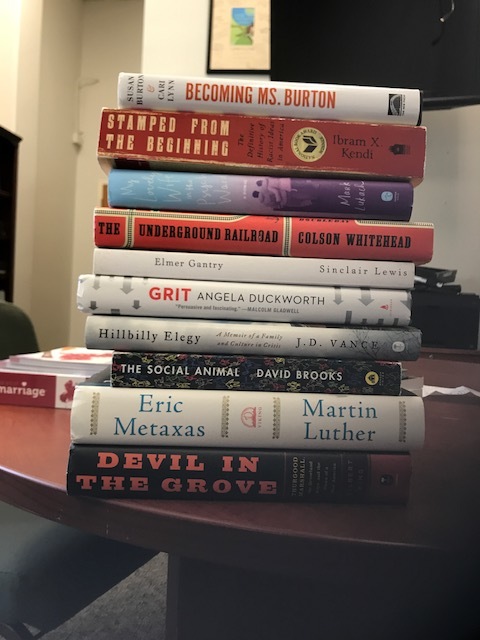
Top Ten of 2017


Well, 2017 is coming to a close, and it’s been another year where I’ve stumbled across some really great reads. I thought I’d share with you the top 10 books I’ve read this year. You’ll notice the list is very eclectic. From the leader of the Reformation, to a scandalous preacher; from a book about the history of race in America, to one entitled, “Hillbilly Elegy.” It’s obvious there’s not much rhyme or reason to my reading, outside of what interests me at the moment. Here you go:
#10- Becoming Ms. Burton, by Susan Burton and Cari Lynn.
I’m a sucker for urban rags to riches stories. If you liked, A Piece of Cake, you will love this one. Susan Burton is a modern-day hero, having risen from the ashes of drug addiction, prostitution and incarceration. Now she’s reaching back and helping others.
#9- Stamped from the Beginning, Ibram X. Kendi.
The most comprehensive history of race in America that I’ve read. He argues how we haven’t made as much progress as we’d like to believe. Tragic. Kendi also unearths how several Puritan pastors had slaves as part of their compensation packages for the churches they served.
#8- My Lovely Wife in the Psych Ward, Mark Lukach.
This is one of those reads you take on vacation with you. And if you’re a man, you’ll find yourself saying, “I’m just a loser of a husband,” about a thousand times. What an indefatigable spirit he has as he cares for his mentally ill wife.
#7- The Underground Railroad, Colson Whitehead.
Don’t be misled into thinking this is a non-fictional, historical piece on the actual underground railroad. It’s fiction, well-written fiction, where you’ll find yourself swept away by the current of Whitehead’s narrative. .
#6- Elmer Gantry. Sinclair Lewis.
I had heard of this title for years, but it was a dinner with some Gordon-Conwell faculty from the homiletics department where I finally decided to read this tome. This should be required reading for any aspiring preacher. Lewis gets to the perils of a professionalized ministry.
#5- Grit, Angela Duckworth.
Little do my boys know this will be on 2018’s summer reading list. “Greatness,” she argues, “isn’t so much about giftedness or environment, as much as it is about perseverance, a sort of stick-to-it-ness. Grit.”
#4- Hillbilly Elegy, J.D. Vance.
I knew nothing of the people who populate places like the hills of Kentucky and the Appalachian Trail. But since this was a significant part of Trump’s base, and I’ve been writing on the subject, I figured this would be a great place to start my research. Vance’s memoir is compelling. At the end, you’ll conclude the gap is not as wide between the poor whites of Vance’s upbringing, and people of color.
#3- The Social Animal, David Brooks.
Okay, you know already my bromance with Brooks. He’s one of my favorites. His intellectual and writing powers are on full display in this book. You won’t be disappointed.
#2- Martin Luther, Eric Metaxas.
Best biography I read all year. There’s not the usual one-hundred-page, build up that’s requisite in most biographies. He practically gets right to the point while providing adequate information. It feels a bit like a novel. Plus, Luther is just flat out interesting, and hilarious.
#1- Devil in the Grove, Gilbert King.
Stunning read. I knew little of Thurgood Marshall’s pre-SCOTUS days. Never knew the risks he took just to try cases in the deep south. He was almost lynched. This book looks at one of his cases, and just when you think there are no more twists and turns, there are!

The Fingerprints of Jesus Luke 4:16-30


It was an early September morning in 1910 when Clarence Hiller was murdered. His wife immediately got in touch with the police, who within an hour found a man believed to be his killer by the name of Thomas Jennings. He had blood on him, and his arm had been injured badly. And yet, it was obvious the police had no clear proof that Jennings had committed the crime. So they began poking around the Hiller home, and they discovered that whoever killed Clarence had come in through the kitchen window leaving four fresh fingerprints. It’s here where they decided for the first time in U.S. history to submit fingerprints as evidence in a case, and they won the conviction sending Jennings to jail.
Creating the Need
All of us in this room have a unique set of ridges on our fingers called fingerprints. These ridges are so unique that no two people have the same exact pattern. Our fingerprints are key to our identity. When it comes to Jesus Christ, I want you to see the four biographies written about him called the gospels, as his unique fingerprints. They point to the unique identity of Jesus Christ. What is that unique identity? Jesus Christ is the Messiah, the anointed Son of God. He’s not just a good man. He’s not some prophet, nor was he a fictional character. He was a real person, who made real valid claims of deity, died a read death and rose to a real life so that we could have a real future and a real hope. This is who Jesus is! And over the next several weeks of advent season I want to draw our attention to the fingerprints, the identity of Jesus.
Now some of you are here and you would say, not buying it. I just can’t accept that Jesus was God. He was a good man, not God. Listen to what the lead singer of U2, Bono, says to this, “I think it’s the defining question for a Christian: Who was Christ? And I don’t think you’re let off easily by saying, ‘A great thinker,’ or ‘A great philosopher’. Because actually, he went around saying he was the Messiah. That’s why he was crucified. He was crucified because he said he was the Son of God. So, he either, in my view, was the Son of God, or he was nuts! When people say, ‘Good teacher,’ ‘Prophet,’ ‘Really nice guy,’ this is not how Jesus thought of himself. So you’re left with a challenge in that, either Jesus is who he said he was or a complete and utter nut case. And I believe that Jesus was, you know, the Son of God”- Bono, Focus on the Family Interview, 2013.
Do you get what Bono is saying? The defining question of your life, that everyone must answer, is who was Jesus? Now here’s where Bono nails it- If anyone says they are the Messiah you have one of two extremes. Either they are completely nuts, or they are completely right, no middle ground. And if Jesus is who he said he is, then this completely changes everything. I must take him seriously. I must see his words not as some tweets to contemplate, but inspiring directives to organize our life around. This is Jesus.
I want you to track with me over the next several weeks as we look at the fingerprints, the identity, of Jesus. No this is not going to be a series of lectures in which I prove to you his identity, as much as it will be a series wrestling with what it really means to follow Jesus, this man who said he was the Messiah. Because if he is right- and he is- then we need to know what it means to follow him. So my hope is if you’re not a Christian you are convinced and inspired to follow him. If you are a Christian that you will be inspired and emboldened to follow him even closer. Let’s look at it.
The Identity of Jesus is Comprehensive- Luke 4:16-19
As we come to Luke 4 you should know this is right at the beginning of Jesus’ public ministry. In Bay area speak our passage represents Jesus’ IPO- his initial public offering. This is a key moment in the life and ministry of Jesus. So where do we find Jesus? He’s in the synagogue, Luke notes, “as was his custom”. I love this, and won’t park here for too long. In other words, Jesus made a regular practice of going to church every week. That’s interesting. Jesus, who is God, who wrote the book, and was the focus of the worship songs that were sung, went to church every week. It was his custom to be a part of corporate worship. If Jesus prioritized this, then how much more so should we? And while in church, Luke says Jesus goes up onto the stage, unfolds the Scriptures to what we know as Isaiah 58 and Isaiah 61, reads the verses, and says repeatedly that what you just heard has been fulfilled in me. Drops the mic and sits down! Do you see why we say you don’t have the option to say he was just a good man. Like if I did what he did I’m either crazy or who I said I was, no middle ground.
Now Jesus has just created a real awkward moment, hasn’t he? There’s a tension in the room. And if you are in the room you’re left with a huge question of what am I going to do with this? That’s what Jesus does now. Jesus comes in and creates awkward moments in our lives when we least expect it. He creates one in here every week when we give the altar call. Let’s call it what it is- it’s awkward to walk down front and to say I don’t have it all together and I need Christ to fix me. This is what Christ does, he creates awkward moments. Or when you’re just driving along and Christ begins to speak to you about the way you just talked to your roommate on campus and he asks you to repent. Awkward. Or when Christ begins to speak to you about that sinful relationship you’re in and he asks you to end it. Awkward. Or when he asks you to give a generous gift you hadn’t financially planned for. Awkward. Oh yes, Jesus is still in the business of awkward, and the great question of our lives is how will we respond when Jesus drops the mic on us?
But look at what he says in the sermon. Look back at verses 16-19 with me. Now the question on the table is, who are the poor, the blind, the captives and the oppressed? Is this literal or spiritual? Scholars are agreed- it’s both, and this gels with the ministry of Jesus. If you want to investigate the ministry of Jesus you know that he came to offer salvation to those who are spiritually poor, spiritually blind, spiritually held captive and spiritually oppressed. He did this by calling people to repent for the kingdom of heaven is at hand. So here we see the spiritual sense of it. But we also see Jesus literally opening the eyes of the blind, literally feeding people, literally calling us to visit those in prison, and to reach out to the financial poor and marginalized. So that we see the identity of Jesus, his fingerprints are comprehensive. The gospel he proclaimed was both spiritual and social! This is the way of Jesus.
To go the way of Jesus is to model and proclaim a comprehensive gospel that touches both the spiritual and social needs of people. This is the legacy of Christianity we come from. It was the early Christians who not just met on Sunday mornings to pray, but were the first to care for the hurting in Rome. In fact, one Roman emperor complained that Christians were taking better care of their hurting than Rome! It was Christians who held church councils defending the deity of Jesus and started hospitals for the sick. It was the father of the reformation, a Jesus loving man named Martin Luther, who defended salvation by grace alone through faith alone, but who also put himself in harms way by caring for the sick in a town that was ravaged by a plague. It was a Jesus loving group of “evangelical” Christians in the 18th century called the Clapham Sect who took on and brought down slavery. And it was Christians who marched in the streets of Selma, Birmingham and other places singing the songs of Zion while standing up for voters rights. See, the Bible has no category for a Christianity that is content with Bible studies, church attendance and prayer meetings while doing nothing to address the needs of the hurting.
This is why our commitment at ALCF through our justice and compassion ministry lead by Cheryl Degree is to provide you with opportunities to get your hands dirty by walking with those who are in prison, supporting those who have gotten pregnant out of wedlock and feeding the homeless. In fact, one of the best things you can do today is to go sign up for our angel tree project where you can get gifts for children of the incarcerated. This is the identity of Jesus, and the way of the Christian! This is what it means to follow him!
The Identity of Jesus is Connected to the Needy- Luke 4:23-27
So Jesus ends his sermon, says he is the fulfillment which is him saying he is God, and then Luke notes the crowd began to say to each other, Hey, ain’t that Joe’s boy. We know him. Jesus cuts in and says that doubtless they will quote the proverb saying, Physician heal yourself. What does this mean? This was a proverb that pretty much says it’s one thing for a physician to heal others, but if he can’t heal himself then that’s a problem. Now, Jesus is in Nazareth which is his hometown. They have heard that he’s done some things in other towns and areas. So when they say, Physician heal yourself, they’re saying, if you are really who you say you are prove it to us by doing some kind of a special act right here in your home. In other words, they want Jesus to be like an actor and audition for them, and if he passes the audition then they’ll sign on and follow him.
This still goes on today, and it’s some of you sitting here. In some way you’re saying your own version of this proverb to Jesus. I’ll follow Jesus when he cures me of cancer. I’ll follow Jesus if he fixes my finances. I’ll follow Jesus if he brings my child back to a healthy place. I’ll follow Jesus if he ends the suffering. This is what a young Steve Jobs did. As a little boy he walked into his church one day and demanded to speak to the pastor. He said to the pastor, Can God fix anything? The pastor said yes. Jobs then took out a magazine with a picture of children starving and said then why won’t God fix this? Unsatisfied with the answer Jobs stormed out and never went back to church. Jesus had unfortunately “failed” his audition for Jobs. Now you do see the problem here, don’t you? When we demand that Jesus audition for us, we are putting ourselves in the seat of authority, and making Jesus subservient to our demands, and he will have none of that.
So how does Jesus respond to this proverb? He tells them two quick stories. Notice the similarities. Both have people of great need. Both are Gentiles. Both go to powerful spiritual leaders who happen to be Jewish men. One happens to be financially rich, and the other financially poor, but it is their need that drives them to get help. And this is the point Jesus is making. Jesus likens himself to Elijah and Elisha and says in so many words, I am only here for those who see their need, to those who have found themselves in dire straits. In fact, just one chapter later, Jesus will say I haven’t come for the healthy, but for the sick.
Some years ago a friend of mine went to the doctor for his annual physical. They did their usual poking and prodding, asked questions and ran some blood work. A few days later he got a call to come in because his blood work was off. They ran some more tests and discovered he had cancer. They operated, and got it, and today he’s fine. But I’ll never forget what he said. He said he felt completely fine, and the scary part was if he would have allowed how he felt to keep him from the doctors, things could have been far worse.
The problem with many people here in the Bay is they feel fine. Life is great. But they don’t realize that lying under the hood of their life is a devastating disease with eternal consequences called sin. And until you really see and embrace this, you will never go to the Great Physician, Jesus Christ. This is why one of the greatest gifts Jesus can ever give to someone is pain, because it alerts us to our need with the hopes of sending us running to him!
Now what does all this mean for us as Christ-followers? Several things, but let me give you one. If Jesus came for the needy, then the way of Jesus is for us to immerse ourselves with people who are just needy- both spiritual and literal. We need to be around non-believers and the poor. Some years ago I began to be alarmed by the nauseating level of materialism that was in my heart. So I quietly signed up to serve at a local treatment center for addicts. I would go once a week, not to preach, but just pick up trash and clean toilets and talk to the men. This lead to Korie and I throwing a party for them at our home where the whole program came. They ate me out of house and home, but that was one of the best seasons of my life. For the good of our own souls, we need to be with broken needy people not to fix them, but because it reminds us of our own brokenness and neediness, driving us to the Savior.
The Identity of Jesus is Confrontational- Luke 4:28-30
When Jesus gets finished with the story the crowd is not pleased. They’re angry. So angry they form what one scholar calls a lynch mob and they try to kill him. But why? These stories seem really benign? Why are they so ticked? Well, because Jesus likens himself to two great prophets and says that while there was great need in Israel, the only one’s who got helped were these two Gentiles. These words insult their Jewish sensibilities, because the Jews thought they had a monopoly on the favor of God. After all they had kept the law. They had gone to temple. They had memorized the law. They were the keepers of the Sabbath. So because of all their good deeds they thought they deserved to have the Messiah to themselves. Jesus’ words cut against the grain of their moralism.
What is moralism? Moralism is basing my identity, esteem and self worth on my own good deeds and performance and not on what Christ has done for me on the cross. Moralism says that because I go to church, give money, serve in ministry, lead or attend a growth group that I deserve certain things. Moralism produces a spiritual entitlement of sorts where I think I’m exempt from hard times. Listen to what Tim Keller says, “If I obey, if I follow everything the Bible says, if I never miss worship, if I’m very, very good in every way, if I follow every one of the rules, then I have God where I want him. He owes me. He has to give me a good life. He has to answer my prayers. The way you can tell you have that same hostility, the way you can tell that through your obedience you’re rebelling against God, is when he does anything in your life that shows he doesn’t feel like he owes you anything, you go through the roof- TIM KELLER. This is the Jews- they go through the roof. You?
I had a great friend growing up in Atlanta. This man loved the Lord and had a deep love for the Word of God. We would do bible studies together, and serve in ministry together. He even went off to seminary. He also had a passion for music, and did quite well, so well that he was promised a contract by a top executive in California. We were roommates when I lived in LA and we talked about his dreams of making it big. But then the bottom fell out and he never got that contract. When this reality settled in, he renounced his faith, ended up divorcing his wife and years later is far from Christ. He murdered his relationship with God, because God didn’t do what he wanted him to do. Do you act like the Jews when Jesus fails to meet your expectations for life? Have you gone down the path of moralism seeking to put God in your debt? Or do you do good things because you simply love him?
Prayer of blessing over the people…YOU ARE SENT!