
Helping Your Haters - Joshua 10
It’s been the longest, most agonizing day of her life. She watched her young son being kidnapped and forced into a car. With no time to think, she doesn’t call 911 and, instead, chooses to pursue her son’s kidnappers at high speed for the next several hundred miles. Along the way, she ends up killing them, getting into a car accident that almost costs her life and finally rescuing her child. If you saw this movie, Kidnap starring Halle Berry, you leave absolutely assured of this mothers love for her child. She is relentless and unflinching in her love for him.
Creating the Need
Hard times and duress has a way of serving as a sort of MRI revealing the true nature of our hearts and what we really love. Suffering has never wrecked a person’s faith, but it has always revealed a person’s faith. And one of the clearest ways to know what’s in your heart, is how do you respond to your haters, to those who have betrayed, wronged and hurt you?
This is exactly what’s in view in Simon Wiesenthal’s classic, The Sunflower, in which he tells the true story of the time in which he was serving as a Jew in a Nazi camp when a dying Nazi soldier, who had been responsible for killing hundreds of Jews, asks Simon to forgive him for all of his atrocities. The last part of the book is a round table discussion of sorts where various dignitaries and faith leaders chime in on how Simon should have responded. One of them said, “It always seemed to me inhuman and a travesty of justice if the executioner asked the victim to forgive. One cannot, and should not, go around happily killing and torturing and then, when the moment has come, simply ask, and receive, forgiveness. In my view, this perpetuates the crime.”—Herbert Marcuse. There it is. When in the face of such injustice and inhumanity, what a person really believes comes out. How about you?
Historical Context
This is exactly what’s in view when we come to our text this morning. Just one chapter earlier, Gibeon had wronged and hurt the people of God deeply through an intense act of betrayal. Now in our story, Gibeon—the very one’s who had betrayed them—is in need. It’s here where we see God and Israel’s incredibly gracious heart as in an insane act of grace as they rush to their betrayer’s side and rescue them. What grace!
This ancient story still holds modern relevance. You want to really know what’s in your heart? How do you respond to your Gibeonites—those who have deceived, wronged, betrayed and hurt you? Of course I want to be careful here. This text is not about reconciling with that abusive ex (please hear me on this), but there are some broader applications to be made. If we really want to know where we are with God…if we really want to discern the intensity of our Christianity, how do we respond to the Gibeonites in our lives? How do you handle that dad who walked out on you? How do you respond to that ex who cheated on you, causing you to file for bankruptcy and abandon the life you once enjoyed? How do you respond to the former pastor who split the church and took away your friends? How do you react to that so-called friend who broke their promise? What do you do with the person who perpetrated the act of racial injustice towards you? How do you handle Gibeon? If you haven’t figured it out now, this story is all about grace.
Grace is Hard | Joshua 10:5
This is the last battle described in detail in the book of Joshua. What we see in verse 5 is that a large coalition forms to fight against Gibeon because they are ticked off they would have the nerve to make a peace treaty with the very nation who threatened their existence. Gibeon catches wind of this and see how they respond in verse 6. What’s interesting here is if you study Gibeon’s words in Hebrew they are all imperatives, which is an emotionally intense mood. It is as if Gibeon is hollering, “HELP!” to Israel.
Now I don’t know about you, but if I’m Israel, and the one’s who just betrayed me hollered help, I’m going to be like, “Look at God! Ain’t God good? Won’t he do it? Won’t he will?” I mean this is like that ex who has refused to make child support payments and is now asking me for a loan. Won’t he will? But it’s here where God flips the script and ends whatever thoughts of jubilation Israel may have had. Because God says go help them, and I will be with you. Yep. God is like, “That’s right, the very one’s who wronged you, go help.” See friends, grace is not passive. It is not just the refusal to exact vengeance. Grace is active, it’s rushing to the battlefield to help your enemy. And this is the first of three things we are going to learn about grace this morning, and that is…grace is hard.
In one of his books, Ravi Zacharias tells the story of a husband and wife who were in a heated argument. The husband got so angry he threw acid in his wife’s face, severely deforming her for life. He then left her and his family for another woman. Years later, this man fell on hard times. He was completely destitute. In a Gibeonite act of desperation, he reached out to his ex wife—the one he poured acid on—and asked if she could care for him. To the shock of her children, she did. When asked by them how could she do such a thing, she simply said, “She’s Christian, and to be a Christian is to show grace.” Grace…even to Gibeon.
Do Not Be Afraid
Grace is hard. Easier said than done, I know. Here is Israel, not only is she asked to show grace to Gibeon—the one’s who wronged them—but to help them against a coalition much larger than they. Talk about hard! Israel doesn’t have the resources or the manpower to defeat them on their own. It’s impossibly hard. I want you to think right now of the person who has hurt and wronged you the most. Got it? What if God told you to help them? You may be like, “That’s too much to ask. That is a hill too big for me to climb!” Maybe you even have some fear in you. Fear if they’ll accept your offer of help. Fear of being rejected. The same kind of fear Israel had. Hear what God says to Israel. He says it to you, in verse 8: “Do not be afraid.
You know these four words, “do not be afraid,” are constantly rolling off of God’s words to His people in the Scriptures. In Exodus, God tells Israel, “do not be afraid.” God tells Moses, “do not be afraid.” God tells Joshua several times, “do not be afraid.” God tells Gideon, “do not be afraid.” God tells Elijah, “do not be afraid.” God tells Hezekiah, “do not be afraid.” God tells Jehoshaphat, “do not be afraid.” God tells Isaiah, “do not be afraid.” God tells Mary, “do not be afraid.” God tells Joseph, “do not be afraid.” Jesus tells his disciples many times, “do not be afraid.” God tells Paul, “do not be afraid.” God tells wives, “do not be afraid.” Jesus tells the church in Revelation 2, “do not be afraid.” Did you know God only says this to people who are facing impossible challenges, and are contemplating huge risks? He doesn’t say this to people playing it safe. And to you and me, He says to us—when faced with a huge challenge of showing grace to those who have wronged us—“do not be afraid.” Grace is hard, but God is with us! “Do not be afraid!”
Grace is Hereditary | Joshua 10:8–9
God says, “Israel, I want you to go out there and show grace to them, and you can do this because I am with you.” This is His point in verses 8–9. Look at it with me. Now the fact that God would say, “I am with you,” blows my mind, because Israel had blown God off in chapter 9 by ignoring Him. Now, one chapter later, God says, “I am with you,” What grace! If you haven’t picked up on it by now, grace is not just a NT doctrine, it’s laced all throughout the Scriptures. We see it in the book of Joshua. Chapter 7 Israel sins by taking the devoted things and loses the battle to Ai. One chapter later, God graciously gives them a do-over and they win. Chapter 9 Israel ignores God. One chapter later, God graciously gives them a do-over. Anyone grateful for the gracious do-over’s God has given them? But don’t miss the point. God is saying, “You can give grace to Gibeon, because I’m giving you grace by being with you.” To give grace, you must get grace. And this is the second thing we learn about grace—it’s hereditary.
To be a Christian means you have been given grace. Ephesians 2:8–9 says that we have been saved by grace through faith, and not of works. Romans 2:4 says that it was God’s kindness (hear grace) that leads to repentance. Our sins were forgiven because of God’s grace. We have been raised to new life by an astounding act of God’s grace. To be in the family of God means the very fabric of our spiritual DNA is grace. Grace is hereditary.
In the 1954 Cotton Bowl between Rice University and the University of Alabama, the game was a tight knit one with the score being 7-6. Dicky Moegle—the running back for Rice University—took the ball and stormed up the sideline late in the game destined for a sure touchdown. It was here when a player sitting on the University of Alabama’s bench named Tommy Lewis, rose up off the bench and illegally ran on to the field, tackling Dicky Moegle before he could score a touchdown. After the game, when Tommy Lewis was asked by dumb-founded reporters why he came off the bench to tackle Moegle, he shrugged his shoulders and said, “I don’t know. I guess I had too much Bama in me.” This should be the exact response of the believer when the world is shocked we could show grace to others, even our enemies. We should merely shrug our shoulders and say, I don’t know, I guess I have too much Jesus in me! Grace is hereditary.
Grace is Historical | Joshua 10:12–14
So Israel goes out onto the battlefield and they fight, but what’s clear is they don’t fight alone. The text says that God threw their enemies into a panic and, then in verse 11, that while their enemies were fleeing, God threw large stones at them from heaven. Really God? Come on. You throw hailstones at them while they’re fleeing. That’s awesome. I mean that’s like one of those fights in HS when a kid is getting beat, falls to the ground and someone comes out the crowd and gets a kick in, that’s what God is doing here.
Let me just come by your house and say this. God gets in on the fight. Yeah we do our part, but God is doing His part. Listen, you never know what God is up to in the hearts of your haters. While you’re debating, praying and even hurting, God could probably be at work softening their hearts with “hailstones.” So trust God.
It’s here where Joshua makes a crazy request in verses 12–14. Look at it with me. He says, “God, will you make the sun stand still?” Joshua prays the impossible. I mean, His prayer reminds me of what Jesus said we should pray in Matthew 17:20. Can I ask you a question? When was the last time you prayed what felt like an impossible prayer regarding the haters in your life? Prayers like: God can you give me the courage to reach out to my estranged father? God can you give me the boldness to bless my mother-in-law who is always negative? God can you strengthen me to tell that old friend who wronged me that I forgive them, because I’ve been carrying around this hurt too long? Have you prayed the impossible?
Scholars are baffled by our story, and they try to explain it away. So they say things like, well the sun didn’t really stand still, it was a solar eclipse. Or, the sun didn’t really stand still, God just lessened the heat. I’m not here to get into any of these debates. Here’s what you should know: Whatever happened here, it was a historical day. And it’s always a historical day when you trust God to do the impossible, and you extend grace to those who have wronged you! This becomes an historical mile marker in your journey with Jesus!
I have a friend of mine who says that growing up his father remarried after his biological mother died and his step mother, while not treating him mean, never really embraced him. He says he felt the pain of this as a little boy and it created a devastating distance between them, causing him to harbor bitterness towards her for years. Finally, well into adulthood, he gets saved. And as Jesus always does, some time later, he points out the bitterness in my friend’s life, and begins to challenge him to make it right. So my friend gets on a plane and flies thousands of miles away. His heart is racing as he sits down with her, does the gracious thing and says, I want you to know I forgive you, and we are okay. A few short years later, she’s now terminally ill, she reaches out to him and asks if he would care for her. He drops everything and does. She is still amazed by his grace and begs him to share with her where it came from. He shares Christ with her, she becomes a Christian, dies and slips off into eternity with Jesus. The point is clear: His act of grace became an historical moment both in his journey and in hers. She’s now in heaven because of grace.
Gospel Conclusion
Now you maybe saying, why in the world should I do that? Well friend, don’t you see? We were all Gibeon—sinful people whose sin put us in a helpless state, destining us for an eternity in hell. But God, in an act of crazy grace, sent His Joshua, Jesus Christ, to save and rescue and deliver us. And it was the cross and resurrection of Jesus Christ that became the greatest historical moment ever, even greater than the day in our text. Because it was this moment where Satan was defeated and new life was given. Won’t you say yes to Jesus?
12 …remember that you were at that time separated from Christ, alienated from the commonwealth of Israel and strangers to the covenants of promise, having no hope and without God in the world. 13 But now in Christ Jesus you who once were far off have been brought near by the blood of Christ.” So God, give us the strength, to show grace to those who have hurt us, for our good, and your glory! Amen!
YOU ARE SENT!
Why We No Longer Say “Members”

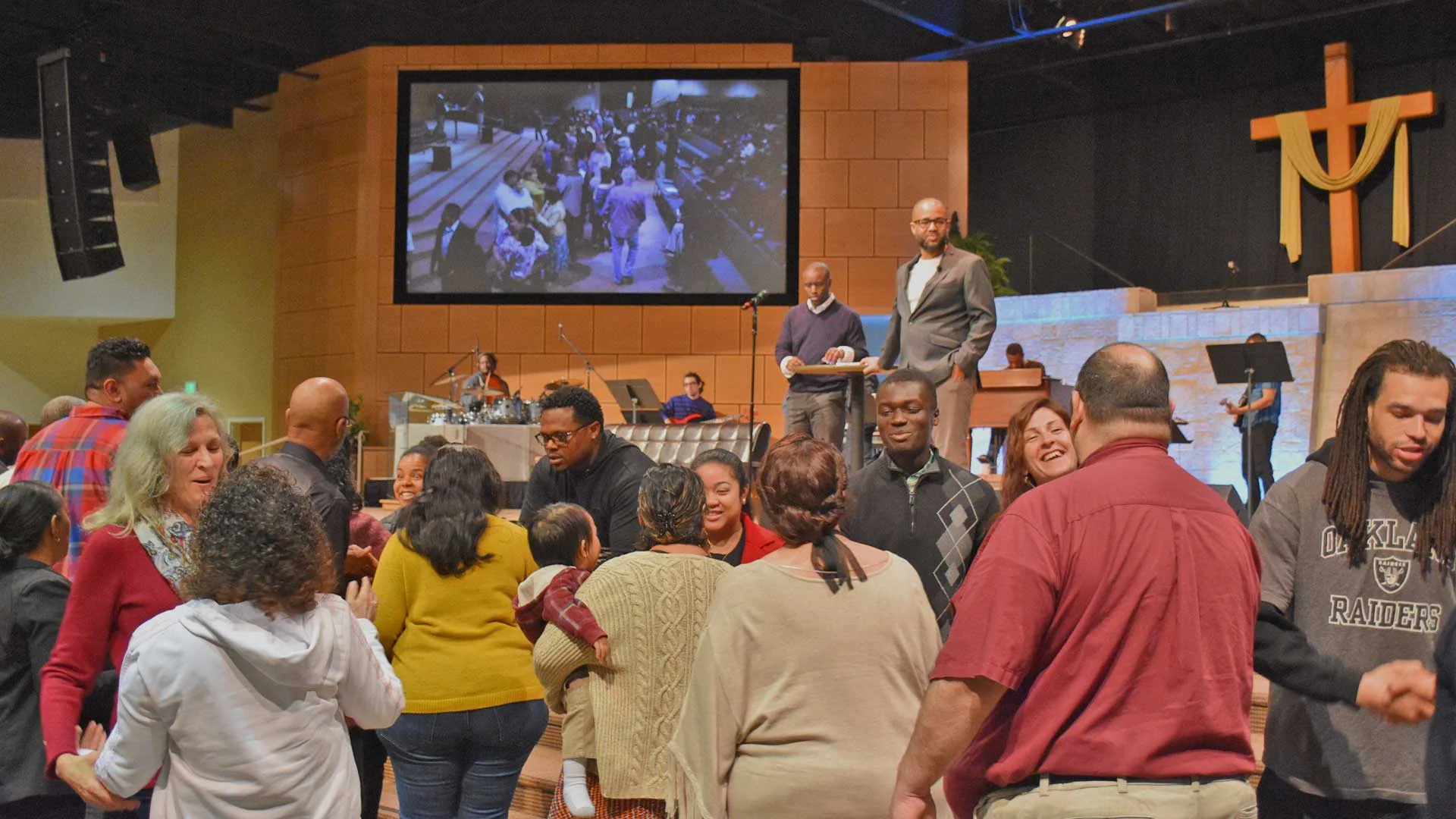
Several weeks ago we instituted a change at Abundant Life where we are no longer using the word member, or membership, and in its place we have decided to use the term covenant partner. This change is not to be cool, hip or up to date (as if the phrase represents any of that), instead it reflects the heart of our church to be the kind of people God envisions. As we think about this change in language, I want to give you three reasons as to why:
1. A culture at war with consumerism. We want to be a church that goes to war with consumerism. Membership instigates a what’s-in-it-for-me mindset. For example, I’m a member of the Delta Skymiles program, where I am afforded a lot of perks. Every year I’m given a free pass to their Sky Club, offered complimentary upgrades to first class, and because of my membership in their program and the status I’ve accrued, my bags typically come out in the first wave. Talk about membership having its privileges! I didn’t become a member of their program to give to Delta, I joined to get. If you’re a member of a country club, travel program or any other entity, you probably asked the question, “What’s in it for me?”. Language is huge in creating culture, so we feel this tweak in language will instigate a spirit of contribution and service, not a one way street of receiving.
2. Rootedness. The word covenant conveys a sense of rootedness. We often refer to marriages as covenants, not contracts. Contracts are performance oriented and transactional. Covenants are more permanent in nature. When we are in covenant with someone, what we are saying is “I am in this for the long haul”. We don’t want to attract a body of “sermon-tasters,” who come for a season, and then move on to the next hottest thing. We want people who feel a sense of call and rootedness to our body.
3. Ownership. A covenant-partner is one who feels a sense of ownership in the church, and when you are that invested you care about what happens and are more prone to participate in the life of our body. Of course we want to be a church that blesses and equips you. My hope is whenever God calls you on you will leave our church thinking you became a much better follower of Jesus because of the things you received from us. But this is a two way street, isn’t it? Our hope is we can say we’re a better church because you used your gifts and passions in a way that blessed and edified our body and the Bay. This is what covenant-partners do.

A Provocative Freedom
We are a nation divided, and those divisions are not new, they’ve just been put on full display through some very recent acts, namely with a group of athletes choosing to take a different posture when it comes to the flag and the playing of our national anthem. A recent ESPN poll revealed what we already know - one’s position on the flag and whether or not to kneel runs along racial lines. The bulk of minorities surveyed are for the protests, while our white brothers and sisters hold a different view.
As Christians we should have a vested interest in this. I believe we have a unique opportunity to display the fragrant aroma of Christ not in our uniformity around this issue, but in how we navigate those differences with one another in all too public forums like Twitter, Facebook and the comments section on someone’s blog post (to name a few). I am going to guess if you’re a Christ-follower that you are a person of the Book, so how should the Scriptures inform our posture with one another. I’ve found the following to be helpful:
1. America is not God’s country. Nowhere in the Bible will you find that America is God’s country. I do believe that God has blessed America with unusual favor in large part because of how we treated the Jews during WWII. God promised in the Abrahamic covenant that he would bless those that blessed the Jews (Genesis 12:1-3), and we are still feeling the aftershocks of that promise. However, there’s no way one can read the Bible and come away with we are God’s country.
2. God doesn’t pledge allegiance to the American flag. Joshua 5 is one of the strangest encounters in the Bible. Here Joshua sees a mysterious man holding a sword and he asks this man whose side is he on- Israel’s or Canaan’s? The man- who is a pre-incarnate appearance of Jesus Christ- says neither, but that he is the captain of the LORD’s army. In other words, Jesus isn’t waving an Israeli flag or a Canaanite one. As Jesus would say centuries later, “My kingdom is not of this world”. Let’s not forget that when the national anthem is played God does not remove his hat, stand up and place his hand over his heart. Sure we should be patriotic, but when our patriotism rises to the level of our allegiance to God we are now guilty of the sin of nationalism.
3. We should show honor and respect to our country and its leaders. Jesus encouraged paying taxes, in fact we find him paying taxes himself. This was an act of honor. The Scriptures instruct us to honor our leaders, even the ungodly ones. Keep in mind when Peter told his audience to
“Honor the emperor,” many scholars believe one of Rome’s most vicious rulers was in power - Nero. It’s a good thing to remove one’ hat, place one’s hand over their heart and show respect to the flag. It is also a good thing to kneel while protesting. Let’s not forget that is why the protests went from sitting to kneeling- to show respect even while protesting.
4. The very historical tradition of Christianity is filled with protests. One need not look any further than the martyrs to see this. The very definition of a martyr is protest. I’m especially interested in Wilberforce, though, who was so incensed over the injustice and inhumanity of the slave trade that he carried on his own protests, one of which was the refusal to eat sugar for what amounted to years. He sparked ire among most in parliament, and many more in England. It is not a stretch to say had he lived today you would find him kneeling when our anthem is played. This, by the way, is not a suggestion to say we should or should not kneel, but to point out the inconsistency of adoring Wilberforce without fully contemplating the present implications of that adoration.
5. Both the Bible and the constitution give us the freedom to kneel or not to kneel when it
comes to the flag. Because the Bible does not speak clearly into this issue, and because our constitution gives us leeway, we have freedom in how we express our convictions.
6. God is okay with offending. Many would appeal to Paul’s discourse on the believer’s stewardship of freedom found in Romans 14 as the guide for our actions regarding the flag. While his principles are mostly helpful to our discussion in whether or not to kneel, we must remember that contextually Romans 14 is worlds a part from the present topic. What Paul is after has to do with how Christians within the local church exercise their freedoms over disputable matters like food. What we are discussing has to do with using freedom as a provocative instrument to address systemic injustice. Wielded irresponsibly, Romans 14 would have found Rosa Parks guilty of sin when she refused to give up her seat thus causing the whites “to stumble”. Obviously this is a misappropriation of the text. What’s more is we see God, at times, instructing people to do provocative and offensive things to bring out a broader point. Was not Ezekiel offensive to the culture when he stripped down to his loin cloth and laid practically naked on his side for three hundred and ninety days? Did not the sight of the preacher (Hosea) with the prostitute (Gomer) offend so many of God’s people? Was not Jesus’ intentional healings on the Sabbath a protest against legalism, and offensive to the religious rulers of his time? The very emblem of the cross is offensive, Paul writes, to Jews and to Greeks. God is fine with offending, as long as it is committed to a greater good.
7. Whatever you do, love. No matter where one’s convictions on this matter leads them, we are bound by love. We have the right to protest. We have the right to protest the protest. We don’t have the right to be mean. An unloving Christian is an oxymoron.

Thanks Dad, For Not (Always) Showing Up
I’m so thankful my dad didn’t come to all of my football, basketball and baseball games. He was thankful too. He never even pretended that perfect attendance at our ball games was a goal, or that his identity was tied into whether or not he showed up. Of course I was excited to see him on occasion standing down the first base line just outside the fence, with his tie loosened cheering me on while I tried to crush the ball. But those days he wasn’t there I knew why- he was working. His absences were a real gift to me, a gift I didn’t fully appreciate until decades later. Dad refused to make me the center of his world.
I recently stumbled upon a pretty gross disorder called Pradar-Willi Syndrome (PWS). The few who are diagnosed with this annually, never get full when they eat. Left without the sensation of satisfaction the individual keeps eating and eating and eating, right into obesity and possibly an early grave. When an individual is inflicted with PWS, good things (like food) can become deadly things.
Many children today are being over-served in the attention department. When children take the place of Jesus as the center of the home, they’re set up for failure outside the home. A sociologist has quipped that ours is the boomerang age, where children leave the home only to return and settle in for extended adolescence. How did this happen? When you were the one everyone orbited around in your home, and then when you left and discovered you’re not the center of the world, of course you’d want to come back to the one place you were.
In hindsight, my father’s refusal to allow me to overdose on attention gave me three gifts:
1. The gift of not being number one. My parents are deep lovers of Jesus, and they always reminded us that we’ve been called into something so much bigger than us, the kingdom. Our extra-curricular activities were scheduled around church attendance, missions trips and service projects (not the other way around).
2. The gift of seeing a man work. Dad’s absence communicated loudly he works. When kids (on occasion) would ask where my dad was, I could tell them he was at work. Work is a good thing. His work paid for my athletic fees, cleats, equipment and uniforms.
3. Resilience. Children are a lot more resilient than we give them credit. My father was easily gone over 100 days a year, and that’s a conservative estimate. While he came to everything he could, he missed a lot. What were the results? Me and my three siblings are all educated, contributing, healthy members of society. We’ve ventured into almost every region of the country hundreds and thousands of miles away from our parents and each other, where we’ve had to start lives and build churches, businesses and community. We’ve got a grit to us because our parents refused to coddle. Thanks dad (and mom).
So relax. Missing a game or a piano recital isn’t a bad thing, it can actually do your children some good.

Mid-Year Top 10
As we head into summer, I thought I’d share with you the top ten books I’ve read so far in 2017:
10. 42 Faith, by Ed Henry- A unique biography that looks at the peculiar role Jackie Robinson’s faith (along with Branch Rickey, the man who signed him to the Brooklyn Dodgers) played in sustaining the first African American Major League baseball player.
9. Sabbath as Resistance, Walter Brueggaemann- I’ve long loved his writings, but this short book on the importance of the Sabbath shows us how we can go to war with the consumer and capitalistic spirit of our western culture.
8. Dream With Me, John Perkins- I had the privilege of endorsing this book, and when I got my advance copy I immediately went to the chapter chronicling the death of his son Spencer. I’ve never heard “pops” (as I call Dr. Perkins) talk about this, and finally and painfully he does. This is just a glimpse into the vulnerability of this work.
7. The Blood of Emmett Till- Timothy B. Tyson- It was the decision to have the open casket of this tortured teenager that sparked the Civil Rights Movement. But it was the lie of the white woman that began the whole journey. She now comes forward and confesses her deceit. What a read.
6. Elmer Gantry, Sinclair Lewis- I’m indebted to the preaching faculty at Gordon Conwell for turning me onto this book. It’s hard to believe this novel was released in the 1920s, because it’s tragically still relevant today. Every preacher must read this as it outlines the spirit of professionalism that tempts us all.
5. The Fire This Time, Jesmyn Ward- Released on the fiftieth anniversary of James Baldwin’s work, The Fire Next Time, this collection of essays offers the best book on race I’ve read in the last five years.
4. The Crucifixion, Fleming Rutledge- Most comprehensive book on the cross I’ve ever read. I will be returning to this book for the balance of my ministry.
3. Becoming Ms. Burton, Susan Burton- A painful true tale of an inner city woman who is sexually abused, beaten, becomes a prostitute and does several stints in jail, only to “break free” and become a vessel of hope in the age of mass incarceration. This redemptive tale follows the likes of A Piece of Cake, and other such works.
2. Lectures to My Students, Charles Spurgeon- Why am I just now reading this? Phenomenal.
1. Outliers, Malcolm Gladwell- I read this when it first came out and then promptly got rid of it, along with 5,000 or so of my other books when we moved to NYC. I missed this work so much I bought and read it again.

When I Don’t Hear From God...


Every last one of us has asked the question, What’s next? High school students trying to figure out where to go for college have asked this question. So have college students trying to lock in on a major (80% will change majors at least once), along with singles who are in a dating relationship and married people needing to discern when to have kids and how many. While these questions defy any unique faith category, Christians have historically filed these under the heading of the will of God. “God, what are you saying?”, we groan when faced with life’s proverbial forks in the road.
But this very question now sparks an age-old theological debate. While Christ followers contend that Christ does speak, we can be at odds over the method. Sure God’s primary voice is the Word of God, but does he also speak audibly? Garry Friesen’s, Decision Making and the Will of God, is weighted towards the no, while the title to Dallas Willard’s, Hearing God, let’s you know where he stands on the question.
If you’re looking for an answer to whether you should attend Stanford or Morehouse, marry Shiela or break up with her or take the out of state job, you just won’t find a chapter or verse in the Bible that will give you that answer. So what are we to do when faced with these decisions? I’ve found the following steps to be helpful:
Step One: Ask Him
In John 10 Jesus describes himself as the door and the Good Shepherd. The metaphor of the door points to salvation- how one gets into the sheepfold of the flock of God. The metaphor of the Good Shepherd depicts Jesus’ relationship with his sheep once they’re in. Then Jesus says, “When he has brought out all his own, he goes before them, and the sheep follow him, for they know his voice” (John 10:4). The Greek word for know is an intuitive knowledge, like the kind of knowing I had when after a few months of dating Korie I just knew she was going to be my wife. Or the kind of knowing one has when they meet someone for the first time and just know something’s not right. It’s that knowledge the sheep have when their shepherd speaks. Do you see what’s being implied here? The Shepherd is speaking long after the sheep have come through the door (of salvation). Jesus speaks.
A few chapters later Jesus pictures the Holy Spirit as our guide. Now what does a guide do? He speaks. When I was a little boy my father taught me the timeless principles of fishing; things like how to bait a hook, cast and reel. A few years ago I went on a fishing trip where I hired a guide. All he did was take the basic truths I’d learned of fishing and he showed me how to apply them in specific places at specific times so that I had great success. This is how the Holy Spirit works with the Word. The Word gives us the timeless principles, and the Holy Spirit- our guide- shows us how to apply them in specific ways. We just need to ask him.
Step Two: Use Wisdom
In his book, Hearing God, Dallas Willard tells the story of a preacher who was out in the middle of a field late one night, and he couldn’t see. The field was full of rocks which made his journey treacherous. Several times he heard someone calling his name. Finally he stopped and felt around. It was a good thing he did this. A few more feet and he would have died. Oh, by the way, he never saw the person who was speaking to him, and concluded it had to have been God.
Can I confess to you that this rarely happens to me. Maybe a handful of times in my whole life have I heard the voice of God in this way. The normal pattern for me is that I pray and ask God to speak into something, and I don’t hear anything. Now what?
There’s a whole section of the Bible called Wisdom Literature. Books like Proverbs, Ecclesiastes and several others make up this genre of Scripture. Wisdom is skillful living. It’s practically applying the timeless principles of Scripture to the specific scenarios of every day life. Now this is interesting, because embedded in the very idea of wisdom is choice.
By the end of this year my boys will be teenagers, and what I’m trying to do, the older they get, is to not tell them exactly what they need to do. Hard, I know. I think good parenting empowers children to make age appropriate decisions. I also think this is how God parents us. A sign of immaturity is the need to be told exactly what to do in every situation. It’s the mature person who can make decisions within certain parameters.
So, when I don’t hear from God, I take that as God saying, make a decision. Now I know this will rub some of you the wrong way, because you think God needs to speak into every decision you make. But can I ask you a question? Did you pray about what pants to wear today? Or if you should wear pants at all? Did you pray about brushing your teeth, or where to get gas? Of course you didn’t, and you shouldn’t. We make decisions every day, wise one’s. It’s the child who needs to be told to brush his teeth. The mature person doesn’t. Again, when you don’t hear anything from God, make the decision, a wise one. But how do we do that?
Step Three: Figure Out the Fences
Imagine your child asks you if she can play in the backyard. You say yes, but a few minutes later she comes in and says can I play on the slide? You agree. A few minutes later she asks if it’s okay to play on the swing set? Of course, you say. Then she asks comes back in moments later and asks if she can play in the sandbox. You look your sweet daughter in the face and tell her your will is she plays within the fences of the backyard, and she can make whatever decision she wants as long as its within those fences.
The same holds true for us. I think it’s good to ask God about our “sandboxes,” but when we don’t hear an answer we have to figure out the fences- those biblical parameters- that will help us make a decision. So, for example, when thinking through a job situation, it’s always helpful to process these fences: 1. Will the job contribute to the common good of society; 2. Will it allow me to provide for my family (As a man this is my call); 3. Has God given me the gifts and capacity to meet the demands of the job? While there’s more questions we could ask, these are the fences. Now we are free to choose.
For more insight into the will of God, tune into our Next series by downloading our app. Type in ALCF in your app store.
The Big 10 of Disciple-Making

Recently our church hosted its first Discipleship Summit- an event focused towards equipping Christ-followers in the Bay in how to lead multiplication movements in their spheres of influence (at home, neighborhood, work, etc). To help us with this we brought in Dr. Kennon Vaughan, one of the worlds foremost leaders when it comes to discipleship. In his second session, Kennon gave what he called, “The Ten How-To’s of Disciple-Making”. Here they are:
1. Pray for the people I want to invest in- I Thessalonians 10:8. This could begin with taking a prayer walk through your neighborhood and praying for your neighbors.
2. Meet them where they are. Disciple-making is not a cookie cutter approach.
3. Start small and raise the bar. Don’t begin the relationship saying you want to disciple them. Instead, try simply inviting them out to lunch to hear their story.
4. A life-on- life approach. Remember, disciple-making is to be in the context of relationships.
5. The goal is heart transformation, not behavior modification. Don’t become a Pharisee obsessed with pointing out their sins.
6. Start with the end in mind. You want them to be a committed follower of Jesus, who reproduces the things you’ve taught them into the lives of others.
7. Stretch them. This could involve having them teach from time to time, or share their faith.
8. Expose them to other faithful people. Don’t make yourself the “star of the show”. We can combat this by inviting others in from time to time who have a long track record of gospel faithfulness and fruitfulness.
9. Involve them in the local church. No, they may not need to come to your church, but it’s important to give them a high view of the local church and encourage them to join one. The apostles knew nothing of disciple-making that was isolated from the church.
10. Be a builder of good curriculum. Disciple-making will force you to study and develop tools that have transferable principles to pass on.

What Does God Have to Say About This Friday Night?

This Sunday we begin a series on dating at Abundant Life called, What Does God Have to Say About this Friday Night? No, I don’t have plans to turn this into a book, or a desire to become the hip church in the Bay. So why am I doing this series then?
A few years ago, for the first time since the Bureau of Labor Statistics started keeping records, the majority of American adults were single (50.2%). If you’re wondering where in America is the best place to find a working single man between the ages of twenty-five to thirty-four, it’s the Bay, with San Jose being the top ranked city in America for available single working men. In fact, around here, San Jose has come to be called “Man Jose,” for these very reasons (By the way, several other Bay area cities rank in the top ten as well). For every one hundred working female singles, “Man Jose,” has one hundred and fourteen. For these reasons and more, every church in the Bay that wants to be viable and flourishing, should have a strategy to actively engage this growing demographic.
Korie and I have three singles living in our home- our kids, Quentin, Myles and Jaden. All of my conversations with them center around one of three areas, we call them “The Three M’s”: Who’s your Master? What’s your mission? Who’s your mate? Answer these three questions correctly and you’re on a trajectory for a God glorifying life rich with meaning.
Any discipleship plan has to hover around these core questions. And while not every single person will marry, just about all will wrestle with the question of who is their mate? Our series is specifically designed to provide meaningful answers to help equip our people in the Bay for how to navigate this area well. This is a part of our core curriculum as disciples of Jesus.
So I hope you’ll join us as we set off this Sunday, using the story of Isaac and Rebekah’s courtship in Genesis 24 as our guide.
To listen to this series download our app in your app store. Just type in ALCF.

Slavery and the Scriptures: Straight Licks With Crooked Sticks
Slavery and the Scriptures:
Straight Licks With Crooked Sticks
There’s certain verses in the Bible that rub me the wrong way. Like when Peter says that slaves are to be subject to their masters (I Peter 2:18). Verses like these remind me that it really is impossible to do theology detached from one’s culture, ethnicity or worldview. We all have a set of lenses through which we see the Scriptures, and the sooner we “see” this truth, the better off we are.
That’s right, my blackness hermeneutically prejudices me.
And so does your whiteness…
Asian-ness…
Hispanic-ness…
And so on…
The great Howard Thurman’s own grandmother refused to even read much of the epistles on account of verses like I Peter 2:18. As a former slave she found herself appalled by the perceived passivity of the likes of Peter and Paul. Her white enslavers actually used these verses as a means to subjugate their slaves to this evil system.
I was sharing my faith recently with a woman on a plane, and one of her first arguments against the veracity of Christianity is that the Bible approves slavery. While she didn’t cite the verse, she was clearly referring to passages like the Peter one to build her case. It was then that I was reminded of the importance to speak intelligently about the Bible and slavery.
Specifically, I have found these two things helpful:
First, Roman Slavery was not American Slavery:
This is pretty straight forward. American slavery was devastatingly based on a system of permanence. Except in the case of rare exceptions, you were a slave for life. In Roman times, however, slaves were typically emancipated at the age of thirty.
American slavery was a system solely based on race. If you were black you were a slave. Period.
Roman slavery was based on conquered nations. Some guesstimate that there were around sixty million slaves at the time of Peter’s writing. Most of these slaves were former professionals. Doctors. Lawyers. Educators. In many instances they were more educated than their masters. And, in most cases their skin color was the same.
The second and most telling thing, however, is that people should know that the Bible does speak very pointedly against what would become the American system of slavery:
“Now we know that the law is good, if one uses it lawfully, understanding this, that the law is not laid down for the just but for the lawless and disobedient, for the ungodly and sinners, for the unholy and profane, for those who strike their fathers and mothers, for murderers, the sexually immoral, men who practice homosexuality, enslavers, liars, perjurers, and whatever else is contrary to sound doctrine” (I Timothy 1:8-10, emphasis mine).
There it is. Paul, the same one who also talked about slaves being subject to their masters, says that enslavers are in the same class as murderers, liars and the sexually immoral.
To be an enslaver is to be a part of a system that captures people made in the image of God and sells them into bondage. What are Paul’s thoughts on these kinds of people involved in these kinds of acts?
They’re godless.
And here is what brings me to my knees:
God allowed godless enslavers who totally misused the Bible to bring people like Howard Thurman’s grandmother, and my great-great-grandfather, along with millions of others to faith in Jesus Christ.
If ever there was a case of God hitting a straight lick with a crooked stick…

Honoring the Cray-Cray: Thoughts on the 2016 Election

A recent New York Times article “revealed” that about half of all voters hold unfavorable views of both presidential candidates. Six in ten republicans, democrats and independents all say they are not looking forward to the coming weeks of this election.
I didn’t need to read the New York Times to get a sense of the despair permeating our country, I just had to drive through my neighborhood.
I haven’t seen one single “Vote for Hillary,” or “Trump” sign on my street.
Or on the adjoining streets.
Or in the neighborhood.
Not one.
Come to think of it, it’s not like they’re popping up all over Silicon Valley where I live and serve.
This election is as the young people say, “Cray-Cray”.
So what are we to do?
In Peter’s first letter he stepped into the political fray and spoke very poignantly to the role of Christians when it comes to government. Now I know Peter’s context is different. He’s writing to Christians under a very authoritarian form of government, while we live in a democracy. But I do believe the principles extend beyond forms.
Honor:
Peter tells believer’s to “honor the emperor” (2:17). Many scholars believe the specific emperor is Nero.
Nero. Now he was “Cray-Cray”. He stabbed his mother to death. Poisoned his aunt with a laxative. Kicked one of his pregnant wives to death in the stomach. Had a boy castrated, and married him. And we haven’t got to the part of burning Rome down and blaming it on Christians followed by his persecution of them.
Honor...Nero?
Well, to be more specific, “Honor the emperor”.
Notice Peter doesn’t mention a name, just a position. Peter is saying that no matter how much we might dislike the person, we are to honor the position.
Korie and I have friends who are trying to teach their young loquacious daughter to show honor. So they came up with an idea. If ever she felt like she was going to say something unkind or disrespectful, to simply cover her mouth. Not long after that the mother and daughter were in a store, and the mother asked her to not do something. Immediately the young girl placed her hands over her mouth. Curious, the mother wanted to know why she did that. The girl said because she was going to tell her to shut-up. The mother took her hand and acted like she was going to smack her on the backside but stopped her hand with her other hand. The daughter asked why she did that? The mother said she was going to spank her!
Funny, but maybe something we Christians should consider. No matter where you land in this election, both candidates have very glaring weaknesses. To honor doesn’t mean we agree with everything, nor does it mean we don’t voice our opinions. Thank God we live in a democracy that allows us to have a voice and a vote. But to honor means we express our views, even our dissenting one’s with respect and kindness and love, even if the other is seen as being unworthy.
Let’s be careful to honor, even those we assume to be Cray-Cray.
Bryan Loritts
Lead Pastor, Abundant Life
Author, Saving the Saved
President, Kainos Movement