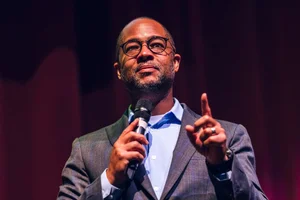
Next level communicators own the room.
Next level communicators own the room.
The venue where we speak is one of the most pivotal factors for the success or failure of our presentations. Think about it. History’s most meaningful messages never took place in subway stations, street corners or empty rooms. Can you imagine President Kennedy’s inaugural address at the seventy-second street station on Manhattan’s upper west side? Or King’s iconic, I Have a Dream speech on Rodeo Drive in Los Angeles? Take their same exact words, which moved generations, and change venues, and they are barely noticed as people rush to their trains or the Gucci store.
I’ll say it again: Where we speak is one of the most pivotal factors for the success or failure of our presentations.
Now let’s keep it real. By the time King climbed the steps of the Lincoln Memorial, he was an established communicator, which meant he got to pick his place. Younger speakers just starting out don’t get to decide where they speak or how many people will show up. Often we are victims of the venue, but this doesn’t have to be the case. I’ve spoken at every sort of place you can imagine. Once I addressed a crowd of seventy something people outside in Israel, while cars whizzed by. When we first planted our church in Memphis we rented a spot called, The Guitar Center. The main area was cool, but a few feet to the left of the stage was a long hallway where kids met for children’s church…in the hallway! Can you imagine the distractions I had to deal with? From there we rented an auditorium that could seat around five hundred on the floor. Sounds pretty cool, but we only had about one hundred people coming to our church at the time. I could go on, but here’s what you have to know, and it’s something most communicators are way too passive about: Your venue will either give or take energy from you as a communicator. The best communicators have learned to turn whatever place they are speaking into an asset for their presentation, but this can only happen when we decide to own the room.
Whoever has the mic owns the room, and since we as communicators are speaking from a place of influence, the audience will help us to turn the venue into an asset. So what are some things you can do when you walk into a room which seats way more people than have actually shown up? Or a crowd that is not really engaging you? Or a place that is filled with distractions? I have found the following to be helpful:
Utilize the density principle. What this means is if you are speaking in a place which seats way more people than have actually shown up, it’s better to squeeze them together than have them spread apart. When we were at the auditorium in Memphis we utilized this principle by roping off the sections on the far left and right, and having people sit close together in the middle. This was huge from an energy standpoint, which I fed off as a communicator. No, you probably don’t carry rope with you when you speak, but you can ask people to squeeze together. If you don’t feel comfortable doing it, ask the host to give you some help.
Be what the room needs you to be. One of the most critical moments in my development as a communicator happened when I began speaking for a ministry which did marriage conferences in hotel ballrooms. After my first conference, my mentor told me he could tell I was used to preaching in churches, because while my content was good there was a significant difference between a church and a ballroom. In a ballroom he encouraged me to be more relaxed, more personal. And then he ended by saying to always be what the room needs you to be. That’s not just true with ballrooms, but with the size of the crowd as well. The smaller the crowd the more relational I become in my presentation. I may lay a hand on someone’s shoulder, or even sit down. These small touches are not small, but go a long way from flipping the venue from being against you to being for you.
Travel with your own microphone. Can you imagine showing up to a conference where you were told hundreds of people would be there, but only fifty come, and the only thing they have to offer you is a microphone attached to a lectern? So you are forced to stand in one spot…to assume a formal posture, to a room of fifty people. Not good. Invest in a great microphone with various adapters which can fit all kinds of mic packs. This will provide you with the flexibility and mobility you need to turn the energy of the room into your favor.
They will mimic your energy. There have been times I’ve looked at the crowd and realized this is going to be tough. Maybe it’s because I’m speaking right after lunch, or later in the day when they are clearly ready to go home, or in a space that’s energy deficient. It’s in these moments I have a pep talk with myself right before I hit the stage, where I say, “Crank up the energy Bryan.” You want them to be energetic and engage, you be energetic and engage.
What I’m Reading:
The Habit of Being: Letters of Flannery O’Connor.