
When I Don’t Hear From God...


Every last one of us has asked the question, What’s next? High school students trying to figure out where to go for college have asked this question. So have college students trying to lock in on a major (80% will change majors at least once), along with singles who are in a dating relationship and married people needing to discern when to have kids and how many. While these questions defy any unique faith category, Christians have historically filed these under the heading of the will of God. “God, what are you saying?”, we groan when faced with life’s proverbial forks in the road.
But this very question now sparks an age-old theological debate. While Christ followers contend that Christ does speak, we can be at odds over the method. Sure God’s primary voice is the Word of God, but does he also speak audibly? Garry Friesen’s, Decision Making and the Will of God, is weighted towards the no, while the title to Dallas Willard’s, Hearing God, let’s you know where he stands on the question.
If you’re looking for an answer to whether you should attend Stanford or Morehouse, marry Shiela or break up with her or take the out of state job, you just won’t find a chapter or verse in the Bible that will give you that answer. So what are we to do when faced with these decisions? I’ve found the following steps to be helpful:
Step One: Ask Him
In John 10 Jesus describes himself as the door and the Good Shepherd. The metaphor of the door points to salvation- how one gets into the sheepfold of the flock of God. The metaphor of the Good Shepherd depicts Jesus’ relationship with his sheep once they’re in. Then Jesus says, “When he has brought out all his own, he goes before them, and the sheep follow him, for they know his voice” (John 10:4). The Greek word for know is an intuitive knowledge, like the kind of knowing I had when after a few months of dating Korie I just knew she was going to be my wife. Or the kind of knowing one has when they meet someone for the first time and just know something’s not right. It’s that knowledge the sheep have when their shepherd speaks. Do you see what’s being implied here? The Shepherd is speaking long after the sheep have come through the door (of salvation). Jesus speaks.
A few chapters later Jesus pictures the Holy Spirit as our guide. Now what does a guide do? He speaks. When I was a little boy my father taught me the timeless principles of fishing; things like how to bait a hook, cast and reel. A few years ago I went on a fishing trip where I hired a guide. All he did was take the basic truths I’d learned of fishing and he showed me how to apply them in specific places at specific times so that I had great success. This is how the Holy Spirit works with the Word. The Word gives us the timeless principles, and the Holy Spirit- our guide- shows us how to apply them in specific ways. We just need to ask him.
Step Two: Use Wisdom
In his book, Hearing God, Dallas Willard tells the story of a preacher who was out in the middle of a field late one night, and he couldn’t see. The field was full of rocks which made his journey treacherous. Several times he heard someone calling his name. Finally he stopped and felt around. It was a good thing he did this. A few more feet and he would have died. Oh, by the way, he never saw the person who was speaking to him, and concluded it had to have been God.
Can I confess to you that this rarely happens to me. Maybe a handful of times in my whole life have I heard the voice of God in this way. The normal pattern for me is that I pray and ask God to speak into something, and I don’t hear anything. Now what?
There’s a whole section of the Bible called Wisdom Literature. Books like Proverbs, Ecclesiastes and several others make up this genre of Scripture. Wisdom is skillful living. It’s practically applying the timeless principles of Scripture to the specific scenarios of every day life. Now this is interesting, because embedded in the very idea of wisdom is choice.
By the end of this year my boys will be teenagers, and what I’m trying to do, the older they get, is to not tell them exactly what they need to do. Hard, I know. I think good parenting empowers children to make age appropriate decisions. I also think this is how God parents us. A sign of immaturity is the need to be told exactly what to do in every situation. It’s the mature person who can make decisions within certain parameters.
So, when I don’t hear from God, I take that as God saying, make a decision. Now I know this will rub some of you the wrong way, because you think God needs to speak into every decision you make. But can I ask you a question? Did you pray about what pants to wear today? Or if you should wear pants at all? Did you pray about brushing your teeth, or where to get gas? Of course you didn’t, and you shouldn’t. We make decisions every day, wise one’s. It’s the child who needs to be told to brush his teeth. The mature person doesn’t. Again, when you don’t hear anything from God, make the decision, a wise one. But how do we do that?
Step Three: Figure Out the Fences
Imagine your child asks you if she can play in the backyard. You say yes, but a few minutes later she comes in and says can I play on the slide? You agree. A few minutes later she asks if it’s okay to play on the swing set? Of course, you say. Then she asks comes back in moments later and asks if she can play in the sandbox. You look your sweet daughter in the face and tell her your will is she plays within the fences of the backyard, and she can make whatever decision she wants as long as its within those fences.
The same holds true for us. I think it’s good to ask God about our “sandboxes,” but when we don’t hear an answer we have to figure out the fences- those biblical parameters- that will help us make a decision. So, for example, when thinking through a job situation, it’s always helpful to process these fences: 1. Will the job contribute to the common good of society; 2. Will it allow me to provide for my family (As a man this is my call); 3. Has God given me the gifts and capacity to meet the demands of the job? While there’s more questions we could ask, these are the fences. Now we are free to choose.
For more insight into the will of God, tune into our Next series by downloading our app. Type in ALCF in your app store.
The Big 10 of Disciple-Making

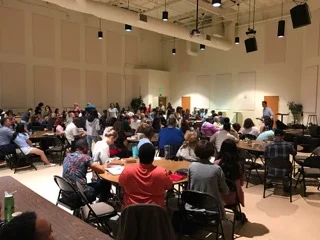
Recently our church hosted its first Discipleship Summit- an event focused towards equipping Christ-followers in the Bay in how to lead multiplication movements in their spheres of influence (at home, neighborhood, work, etc). To help us with this we brought in Dr. Kennon Vaughan, one of the worlds foremost leaders when it comes to discipleship. In his second session, Kennon gave what he called, “The Ten How-To’s of Disciple-Making”. Here they are:
1. Pray for the people I want to invest in- I Thessalonians 10:8. This could begin with taking a prayer walk through your neighborhood and praying for your neighbors.
2. Meet them where they are. Disciple-making is not a cookie cutter approach.
3. Start small and raise the bar. Don’t begin the relationship saying you want to disciple them. Instead, try simply inviting them out to lunch to hear their story.
4. A life-on- life approach. Remember, disciple-making is to be in the context of relationships.
5. The goal is heart transformation, not behavior modification. Don’t become a Pharisee obsessed with pointing out their sins.
6. Start with the end in mind. You want them to be a committed follower of Jesus, who reproduces the things you’ve taught them into the lives of others.
7. Stretch them. This could involve having them teach from time to time, or share their faith.
8. Expose them to other faithful people. Don’t make yourself the “star of the show”. We can combat this by inviting others in from time to time who have a long track record of gospel faithfulness and fruitfulness.
9. Involve them in the local church. No, they may not need to come to your church, but it’s important to give them a high view of the local church and encourage them to join one. The apostles knew nothing of disciple-making that was isolated from the church.
10. Be a builder of good curriculum. Disciple-making will force you to study and develop tools that have transferable principles to pass on.

What Does God Have to Say About This Friday Night?

This Sunday we begin a series on dating at Abundant Life called, What Does God Have to Say About this Friday Night? No, I don’t have plans to turn this into a book, or a desire to become the hip church in the Bay. So why am I doing this series then?
A few years ago, for the first time since the Bureau of Labor Statistics started keeping records, the majority of American adults were single (50.2%). If you’re wondering where in America is the best place to find a working single man between the ages of twenty-five to thirty-four, it’s the Bay, with San Jose being the top ranked city in America for available single working men. In fact, around here, San Jose has come to be called “Man Jose,” for these very reasons (By the way, several other Bay area cities rank in the top ten as well). For every one hundred working female singles, “Man Jose,” has one hundred and fourteen. For these reasons and more, every church in the Bay that wants to be viable and flourishing, should have a strategy to actively engage this growing demographic.
Korie and I have three singles living in our home- our kids, Quentin, Myles and Jaden. All of my conversations with them center around one of three areas, we call them “The Three M’s”: Who’s your Master? What’s your mission? Who’s your mate? Answer these three questions correctly and you’re on a trajectory for a God glorifying life rich with meaning.
Any discipleship plan has to hover around these core questions. And while not every single person will marry, just about all will wrestle with the question of who is their mate? Our series is specifically designed to provide meaningful answers to help equip our people in the Bay for how to navigate this area well. This is a part of our core curriculum as disciples of Jesus.
So I hope you’ll join us as we set off this Sunday, using the story of Isaac and Rebekah’s courtship in Genesis 24 as our guide.
To listen to this series download our app in your app store. Just type in ALCF.

Slavery and the Scriptures: Straight Licks With Crooked Sticks
Slavery and the Scriptures:
Straight Licks With Crooked Sticks
There’s certain verses in the Bible that rub me the wrong way. Like when Peter says that slaves are to be subject to their masters (I Peter 2:18). Verses like these remind me that it really is impossible to do theology detached from one’s culture, ethnicity or worldview. We all have a set of lenses through which we see the Scriptures, and the sooner we “see” this truth, the better off we are.
That’s right, my blackness hermeneutically prejudices me.
And so does your whiteness…
Asian-ness…
Hispanic-ness…
And so on…
The great Howard Thurman’s own grandmother refused to even read much of the epistles on account of verses like I Peter 2:18. As a former slave she found herself appalled by the perceived passivity of the likes of Peter and Paul. Her white enslavers actually used these verses as a means to subjugate their slaves to this evil system.
I was sharing my faith recently with a woman on a plane, and one of her first arguments against the veracity of Christianity is that the Bible approves slavery. While she didn’t cite the verse, she was clearly referring to passages like the Peter one to build her case. It was then that I was reminded of the importance to speak intelligently about the Bible and slavery.
Specifically, I have found these two things helpful:
First, Roman Slavery was not American Slavery:
This is pretty straight forward. American slavery was devastatingly based on a system of permanence. Except in the case of rare exceptions, you were a slave for life. In Roman times, however, slaves were typically emancipated at the age of thirty.
American slavery was a system solely based on race. If you were black you were a slave. Period.
Roman slavery was based on conquered nations. Some guesstimate that there were around sixty million slaves at the time of Peter’s writing. Most of these slaves were former professionals. Doctors. Lawyers. Educators. In many instances they were more educated than their masters. And, in most cases their skin color was the same.
The second and most telling thing, however, is that people should know that the Bible does speak very pointedly against what would become the American system of slavery:
“Now we know that the law is good, if one uses it lawfully, understanding this, that the law is not laid down for the just but for the lawless and disobedient, for the ungodly and sinners, for the unholy and profane, for those who strike their fathers and mothers, for murderers, the sexually immoral, men who practice homosexuality, enslavers, liars, perjurers, and whatever else is contrary to sound doctrine” (I Timothy 1:8-10, emphasis mine).
There it is. Paul, the same one who also talked about slaves being subject to their masters, says that enslavers are in the same class as murderers, liars and the sexually immoral.
To be an enslaver is to be a part of a system that captures people made in the image of God and sells them into bondage. What are Paul’s thoughts on these kinds of people involved in these kinds of acts?
They’re godless.
And here is what brings me to my knees:
God allowed godless enslavers who totally misused the Bible to bring people like Howard Thurman’s grandmother, and my great-great-grandfather, along with millions of others to faith in Jesus Christ.
If ever there was a case of God hitting a straight lick with a crooked stick…

Honoring the Cray-Cray: Thoughts on the 2016 Election

A recent New York Times article “revealed” that about half of all voters hold unfavorable views of both presidential candidates. Six in ten republicans, democrats and independents all say they are not looking forward to the coming weeks of this election.
I didn’t need to read the New York Times to get a sense of the despair permeating our country, I just had to drive through my neighborhood.
I haven’t seen one single “Vote for Hillary,” or “Trump” sign on my street.
Or on the adjoining streets.
Or in the neighborhood.
Not one.
Come to think of it, it’s not like they’re popping up all over Silicon Valley where I live and serve.
This election is as the young people say, “Cray-Cray”.
So what are we to do?
In Peter’s first letter he stepped into the political fray and spoke very poignantly to the role of Christians when it comes to government. Now I know Peter’s context is different. He’s writing to Christians under a very authoritarian form of government, while we live in a democracy. But I do believe the principles extend beyond forms.
Honor:
Peter tells believer’s to “honor the emperor” (2:17). Many scholars believe the specific emperor is Nero.
Nero. Now he was “Cray-Cray”. He stabbed his mother to death. Poisoned his aunt with a laxative. Kicked one of his pregnant wives to death in the stomach. Had a boy castrated, and married him. And we haven’t got to the part of burning Rome down and blaming it on Christians followed by his persecution of them.
Honor...Nero?
Well, to be more specific, “Honor the emperor”.
Notice Peter doesn’t mention a name, just a position. Peter is saying that no matter how much we might dislike the person, we are to honor the position.
Korie and I have friends who are trying to teach their young loquacious daughter to show honor. So they came up with an idea. If ever she felt like she was going to say something unkind or disrespectful, to simply cover her mouth. Not long after that the mother and daughter were in a store, and the mother asked her to not do something. Immediately the young girl placed her hands over her mouth. Curious, the mother wanted to know why she did that. The girl said because she was going to tell her to shut-up. The mother took her hand and acted like she was going to smack her on the backside but stopped her hand with her other hand. The daughter asked why she did that? The mother said she was going to spank her!
Funny, but maybe something we Christians should consider. No matter where you land in this election, both candidates have very glaring weaknesses. To honor doesn’t mean we agree with everything, nor does it mean we don’t voice our opinions. Thank God we live in a democracy that allows us to have a voice and a vote. But to honor means we express our views, even our dissenting one’s with respect and kindness and love, even if the other is seen as being unworthy.
Let’s be careful to honor, even those we assume to be Cray-Cray.
Bryan Loritts
Lead Pastor, Abundant Life
Author, Saving the Saved
President, Kainos Movement

Altar Calls

Altar calls. The very phrase takes me back to my grandfather’s Buick where we’d pile in on summer Sunday morning’s in the sleepy town of Roanoke, Virginia and journey to their African Methodist Episcopal church. Sitting on those hard pews in my stuffy three piece suit, I’d always wondered why the pastor preached about such a big God who could do incredible things, but when it came time to get saved they only put two chairs out.
Two? Is that all you were expecting.
Half the time they wouldn’t even fill half of what they were believing this big God for.
Altar calls.
When I went off to Bible college and started to get “grown” in my faith this relic of my past took on a moth-ball kind of texture. Reading a few books about God’s sovereignty, and getting acquainted with the likes of Calvin and his theological progeny made me really believe altar calls were my grandfather’s Buick- a car now acquainted with old men who wore Old Spice, sat in barbershops all day playing checkers.
Altar calls.
My sophisticated and hip perspective was jolted in the mid nineties when I served on staff at a church that did them regularly. I couldn’t believe what I saw every Sunday I served:
About a hundred came to the altar every week.
The average age of the church was around 28.
It was in the heart of Los Angeles, not the Bible belt.
And no they weren’t responding to emotional manipulation, or some hip sermon that was rooted more in the New York Times or latest movie. They were reacting to what a thoroughly exposited text had just exposed, and the prompting of the Holy Spirit.
My wife was one of those who came down to get saved. Almost nineteen years later I can tell you what happened at that altar on that December day was no emotional fluke.
Altar calls.
You won’t see the phrase in the Bible, but if by those two words you mean people publicly pledging their allegiance to Jesus it’s all through the New Testament.
Jesus called people to follow him, and most times he did so publicly.
The book of Acts is riddled with the disciples making appeals for people to publicly follow Jesus.
The Day of Pentecost.
The Gentile Pentecost of Acts 10.
Etc.
I recently took over a church where I inherited their tradition of altar calls. Sure, I’ve got a growing list of things I’d love to change at our church, but these two words aren’t on that list, and I’m not sure they ever will be. Relax. I’m not saying altar calls are a have to. But, and I think this is the most important reason why I’m going to hold onto this rich tradition, altar calls are a glorious, visible, corporate demonstration of the power of the Holy Spirit moving among the people.
I think I’ll say that again:
Altar calls are a glorious, visible, corporate demonstration of the power of the Holy Spirit moving among the people.
I think the reason why the church in Acts exploded is because there was this visible, corporate, glorious sense that something was happening there. You saw people get saved. You saw people repent and burn their books. You saw the Spirit at work. This sensory experience created a buzz. Something was happening here.
In our individualized Western culture, we rob people of the blessing of seeing the Spirit move corporately when we privatize His work in order to not put anyone on the spot.
Of course people can get saved without walking the aisle. See Nicodemus.
And it’s also important to know that the response to the altar call is not the Nielson Ratings on the pastors sermon and how well or poor it was. So we pastors have to get our egos out of the way.
Beyond those two words see the principle. Pastors, our people have a need to see and know the Holy Spirit is at work not just in them, but in His church. Christianity is not individual, it’s communal as well. What venue at your church affords this opportunity for people to see and sense and celebrate the march of the Holy Spirit among the people?
Bryan LorittsLead Pastor, Abundant LifeAuthor, Saving the SavedPresident, Kainos Movement

Figure It Out
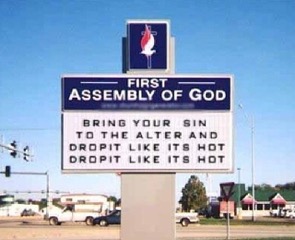
Legalism happens when we try to micro-apply God’s standard of holiness. I was sucker punched by this thought when I studied I Peter 1:15 just the other week, in preparation for preaching: “But as he who called you is holy, you also be holy in all your conduct.”
What does in all your conduct mean? Please tell me more. Spell it out for me.
Should I delete Jay-Z and other “secular” music from my iTunes?
No more Rated R movies?
What about PG-13?
Is five miles over the speed limit acceptable?
What about wiping down my sweaty bike at the end of spin class? I’d been convicted about that, but is that more legalism?
I’m reminded of what Pastor Tom Nelson says, “We Christians would rather have a rule than to think”.
I think he’s onto something. Reading the Bible I’m becoming more awed by how little God actually spells things out.
In the garden he only gave Adam and Eve a handful of rules:
Exercise dominion over and cultivate the garden.
Be one with each other.
Of all the trees in the garden, there’s only one you can’t eat of.
Sure there’s Leviticus with its mind numbing details on what they could and couldn’t eat, touch, etc, but that’s under a theocratic form of government, and those ceremonial laws no longer apply (i.e. Acts 10).
When it comes to the moral law, however, there’s only ten commandments. Ten.
Jesus actually said there’s only two real rules- Love God and love others.
I think when we do these two things Jesus said, we set the stage to just figure it out.
Jesus also said we have the Holy Spirit who will guide us. In other words, it’s the Holy Spirit’s job- not the preachers, or other Christians ultimately- to help us figure it out.
At the first church council in Acts 15, the apostles said new Gentile converts should abstain from food offered to idols, and avoid sexual immorality. Why did they convene? Because some Christians were trying to micro-apply what it means to be holy to new believers.
Figure it out, is an apt three word description for the rest of the New Testament as it relates to rules.
When pressed by the Romans as to whether or not they should eat certain foods, Paul refused to micro-apply holiness. Instead he gave some thirty-five thousand foot perspective:
Honor each other.
Follow your conscience
Let God speak
In other words, figure it out.
If you’re looking for answers about whether or not you can listen to Kendrick Lamar, the most you’ll find in the Scriptures is this offering from Paul:
“Finally, brothers, whatever is true, whatever is noble, whatever is just, whatever is pure, whatever is lovely, whatever is commendable, if there is any excellence, if thee is anything worthy of praise, think about these things”- Philippians 4:8.
Figure it out.
I Peter 1:15 is really a beautiful verse, but it gets mangled when we preachers, parents and well intentioned Christ-followers try to descend from the thirty-five thousand admonition and micro-apply exactly what that means to others. For sure, God is saying Christians should be different, but we need to give each other a lot of latitude as to how that looks.
For me, God is speaking to me at the gym about wiping the sweat off my bike. It’s a subtle way I can look different (unfortunately, it’s not a common communal habit). I also don’t feel the freedom to listen to about 95% of Jay-Z’s songs because he likes to call himself “J-Hova”. But the moment I stand up and say to my congregation that holiness means every Christian has to wipe off their gym equipment, and delete Jay-Z from their iTunes I’ve now overstepped my bounds.
That’s the Holy Spirit’s job.
Thankfully, I’m not him.
Figure it out.

Exiles

It’s August. My house doesn’t have air conditioning, and I don’t need it a bit. If God is looking for a climate to set heaven to, I’m sure he’s taken a hard look at that stretch of the 101 freeway that runs from San Francisco to San Jose.
But more than the climate there’s the palm trees, mountains and ingenuity. There’s an intellectual energy, a creative force that permeates the place. Driving down the street taking it all in it’s easy to think, “Mama I’ve made it”.
A recent CBS News report agrees. In a survey ranking the top ten most desirable places to live in the United States, San Jose ranked tenth and San Francisco 9th- the two bookends to the 101 corridor. Living along this stretch it’s easy to think we’re in heaven.
But we’re not. Peter’s words in his first letter serve as great reminders to we American Christians, especially to those of us living in pockets of the country that have made top ten lists: “Peter, an apostle of Jesus Christ, to those who are elect exiles of the Dispersion…” (I Peter 1:1a). Peter calls us exiles.
The Greek word for “exile” has an oxymoronic feel to it- it literally means a close stranger. It’s the Old Testament equivalent of sojourner; today we’d use the word immigrant. It’s someone from one country, who lives in another, yet it’s obvious they’re not from here. That’s the idea of an exile. Implicit in the word is the notion that this world is not quite home for us. We’re from another place.
This is a good word for us. We’re not from here. As Paul would say to the Philippians, “Our citizenship is in heaven” (3:20). We are journeying onward towards another city, as the writer of Hebrews would say (13:14).
Don’t misunderstand me, nor the writers of Scripture: To be an exile does not equal being uncaring towards people or the environment. God told Israel during the Babylonian exile to build houses, dwell in them and seek the welfare of their city (Jeremiah 29). Christians should fight cancer, engage in the political process and, yes, even pay careful attention to recycle (A point I’ve been made especially aware of living in Northern California).
But to be an exile also means to not get too enamored with this world. Exiles should have a soul level dissonance keeping them from exhaling to themselves, “Mama, I made it”. Exiles intuitively know this life is not all there is.
The more I think about it, there are several things we do to keep our focus on our real home. These practices remind us of our exile-ness (to make up a word):
Constant communication with our true home. Exiles pray. The act of deep, abiding, consistent prayer is one of the best ways to keep an exiles perspective.
Different. Not much longer after calling his audience exiles, Peter would call them to holiness. To be holy means to be different. Exiles are different. In the natural they talk different, have different customs and practices. They are a peculiar people.
UCLA’s great coach, John Wooden, was an exile. Born and raised in the midwest, he was the poster child for conservative, midwestern values, and these values caused him to stick out once he uprooted and moved to Los Angeles. The only “profanity” he was ever heard to say was, “Goodness gracious sakes alive”. When his duties required him to go to cocktail parties, he would raise more than a few eyebrows as he nursed his Ginger Ale, refusing to drink. And coaching in some of the most combustible times like the sixties and early seventies, his conservative roots led him to be pegged “old fashioned,” and out of style. Wooden lived in Los Angeles, but it was clear he wasn’t from Los Angeles. When it was all said and done he accomplished historic amounts of success, and had people dying to learn from him.
To be an exile is not to be a loser, nor is it an eccentric form of people repellent. Wooden teaches us this. While not at home we can be winsome, and even successful by the worlds standards without becoming enamored with it. This is a good word for me during times like August when words like “hot" or “humid" carry no meaning, and air conditioning is irrelevant. I’m just passing through, on my way to my true home. I hope along the way I raise a few eyebrows myself, and point people to God.

Keep It Simple

Anne Lamott argues the best books are those organized around a singular, well-defined topic. So defined, she says, the author is nervous, wondering if they have enough material to draw out a whole book. To Anne (one of my favorite writers by the way), simplicity is the author’s best friend.
It’s also ours.
The gravitational pull of life is into complexity, and away from simplicity. It seems as if every year around January, I exhale and say, “This year just can’t be as crazy as last year,” yet for some reason it becomes just that. More can’t-miss opportunities, once-in-a-lifetime invitations and are you for real, I-can’t-believe-this-is-happening-to-me open doors. And we haven’t even gotten to the obligation side of things. You know, the teenage son who just got a job and needs to be shuttled back and forth, or the new drum lessons for the other son on the other side of town. The list just gets longer.
Some of these complexities are unavoidable and fall into the stop whining and just joyfully lean into it category. I get that. But sometimes, we pile things on our proverbial plates we have no business putting there, to the point where our productivity is not only hindered, but we also fail to steward well God’s unique calling on our lives. For this to happen, we need to learn to keep things as simple as possible, and this is going to be a fight.
We see the apostles fighting for simplicity in Acts 6:4 when—in the midst of a growing church, and presented with an opportunity to take on yet another thing—they said, “But we will devote ourselves to prayer and to the ministry of the word.” Simplicity. Now I’m not here to argue whether or not Acts is given to us to use prescriptively. I’ll leave that up to the advanced Bible scholars and academicians. What we have to be amazed with is their dogged determination to keep things as simple as possible. Prayer and preaching were going to be their priorities. Simplicity.
Many confuse simplicity with being shallow. It’s really the opposite. The ability to clear away the debris, and keep the (overused) “main thing, the main thing,” actually instigates a kind of depth one would not have the time or energy to experience if they were giving attention to too many things. Take preaching. Charles Spurgeon was once asked his philosophy of preaching. He said he takes his text and makes a beeline for the cross. To Spurgeon, his preaching only played one note—the cross. Simplicity. Whatever you may think of “big idea” preaching (having one main idea from the text), what it tries to drive the preacher towards is simplicity. One message, stated multiple ways, that yields a stunning kind of clarity to the hearers.
Simplicity is depth. Simplicity is clarity. Simplicity sets the table for excellence. My favorite restaurants are some of the most simple. Chickfila does chicken. Not hamburgers and tacos. Chicken. Houston’s has a one-page menu where they only offer a few things, but boy do they do them well. With all due respect, my chest tightens when I peruse Cheesecake Factory’s menu. Way too much going on.
In my years in ministry, I’ve watched leaders and preachers hit their peaks, and then start to decline, and my hunch is they tried to take on too much at their height. As Craig Groeschel says, “The greatest enemy to future success is current success.” Imagine it this way: You’re a young preacher starting out, and you meet some of your preaching heroes, and you find that among other things just about all of them love to read. So off you go, you spend a lot of time reading. After all, you do have time, not a whole lot of invitations. But soon people begin to take notice. Invitations begin to trickle in. Soon a church calls you to be their pastor. Growth happens. Sky miles get wracked up. People start pulling on you from all over the place. Book deals come your way and, before you know it, you’ve got all of these plates spinning, and as the years go by you’re reading less and less and less. You’re recycling illustrations. Your study is hurried, and overall your preaching lacks the depth it once had. Well, what happened? Your success brought about complexities, and you lacked the discipline to lock arms with the apostles of Acts 6 and to keep it simple.
Now you can cut and paste with variations to your own life. But you see the point, don’t you? If this preacher was going to continue to grow and deepen in his preaching, he was going to have to fight for simplicity, and keep his life as clutter free as possible. So how do we do this? Let me offer the following things I’m finding helpful in my work to keep things as simple as possible:
1. Focus. Know your gifts, and stay focused on them. No, this doesn’t mean you only do what’s in your wheelhouse, but you primarily do what’s in your wheelhouse. Fifty percent of my work day is dedicated to the study of the Scriptures and reading. The other half I am in meetings, counseling and doing hospital visitations. I’ve decided, like the apostles, to orbit as much as possible around my gifts. Focus.
2. No. People pleasers are magnets that attract clutter and complexity. You are going to have to learn to say no…often. If you read Acts 6, the apostles say no to helping widows who were being overlooked in the daily distribution of food. This seems cold blooded, but remember we’re talking about a mega church where the apostles had the leader resources to compassionately care for these widows. But the bigger point is often times saying no is really hard because it can disappoint others.
3. Empower Others. Beware the Messianic Complex. This is when a problem comes up that somehow people, even you, think that only you can deal with it. More times than not, this is just not true, and if it is true, the bulk of the time then this is a sign of just bad leadership. Acts 6 shows us healthy leadership. The apostles empowered other leaders and unleashed them to care for and lead others well. What happens when we empower and unleash others? Well, our lives as leaders maintain a higher degree of simplicity.
Check out messages by Pastor Bryan on ALCF’s Weekly Teaching Podcast

The “Dreaded Glenn”: A Response to Ms. Gaye Clark

I want to take a few moments to respond to Ms. Gaye Clark’s article posted by The Gospel Coalition, where she offers advice to our white siblings whose children are in interracial relationships. She writes this in response to the surprise she felt when her white daughter brought home a black man donning dreads named Glenn. It’s important for me to say I found her insights to be very well intentioned. I really do believe she gave it the proverbial college try. She shot her best shot. But, the article is misinformed.
Her words bore the aroma of reformed theology and were laced with historical references and the requisite John Piper quote. All standard fare for a blogpost by my beloved friends at The Gospel Coalition. While I do say this with a degree of tongue in cheek, I feel compelled to wade into her insights out of a conviction of mine that some of the most dangerous and divisive threats to the Christian faith and well being are those that seem the most harmless.
Since Ms. Clarke takes us back parenthetically to 1967, maybe I should begin there. This was the year the landmark film, “Guess Who’s Coming to Dinner” came out. As you know this was to many a scandalous work, diving headlong into the subject of interracial marriage, as Spencer Tracey (It would be his last film) and Katherine Hepburn’s San Francisco based characters are thrust into the subject, when their daughter comes home with a black man (played by Sidney Poitier). After initial shock and hesitancy (especially on the part of the dad), they come around and finally embrace him, and you’re left in awe of this “courageous and progressive” white couple who would stand so big while stooping so low as to accept a black man. Think about it- in 1967 a mark of being what we would now call progressive, is accepting a black person. So once the final credits roll what are we left thinking? Oh those great and wonderful white people. Boy isn’t that big of them to accept us. They’re the real protagonist’s, the real heroes, of this story.
And that’s exactly how I felt reading Ms. Gaye Clark’s article. Now whether or not she meant to do that is not the point. I fully believe this was not her intention. But I can’t help it, there is just an air of arrogance and paternalism here. One can easily leave thinking, “Well isn’t that just kind and big of her. This white woman accepting this black man, dreads and all?” It’s this subtlety that actually undermines Ms. Clark’s purpose. Instead of trying to fight against inequality, she actually entrenches it by unintentionally posturing herself as the Katherine Hepburn of this modern day, “Guess Who’s Coming to Dinner”.
But there’s more. Now why is it that we would expect a white person to coach other white people on how to accept a black person into their family, but not expect black people to coach other black people on how to accept Heidi (started to say Becky, but that’s already been taken) into their home? The racially biased innuendo here is that we need to help the “superior” in how to embrace the “inferior”.
One of my sons in the ministry is not only African American but is a richly deep dark chocolate complexion. He and his black wife foster. Not too long ago they fostered a young white girl who immediately took to them, and even called him daddy. With roars of laughter he regaled us of tales of being in some store in their small southern town, and his daughter calling from across the aisle, “Daddy!” while all the white folk looked on with shock and horror. You know why they were shocked. The same reason why we don’t see black folk going on missions trips posting pictures on FaceBook of that impoverished white baby they’re holding: For the historically “inferior,” to help the historically “superior,” is counter-cultural and counter-intuitive. So Ms. Clark’s article only helps to buttress the long running historically sad narrative that white folk need help in embracing the “Dreaded Glenn’s” of the world.
If I were to give Ms. Clark a mulligan, I’d want to see more humility from her. I’d want her to put pen to the culturally conditioned consternation that was in her soul that lead to her surprise when Glenn came to her home for dinner. Why were you surprised and implicitly filled with an initial angst? What forces were at work in your own experience that made this even a significant issue for you? Oh yes they were there for you, just like they are for all of us. I want to hear more about that. Pull us into that pilgrimage.
And, given the reformed undertones of her article, which I love by the way, shouldn’t Ms. Clark’s “Big God Theology,” lead to a robust anthropology. She writes of accepting Glenn as if it was a part of God’s permissive will and not his perfect will. I mean she actually talks about the need to rejoice in the trial. Is that what we are now? A trial? Seen in this light, her eight pieces of advice seem more like strategies in how to cope with some incurable forms of arthritis- you know something you can’t get rid of, but you can take something to make you more comfortable with this less than ideal situation. Oh how my heart breaks.
As if this isn’t enough she pleads with our white siblings to show patience with the white bigots in their family who won’t accept the “Dreaded Glen”. Patience with racist’s. Now this has been the historical christian narrative in this country. This is the very reason why MLK wrote his prison epistle, Letter From a Birmingham Jail, to white clergy (many Christians), who like Ms. Clark pleaded patience. No, what we need is a kind of awkward prophetic courage that has the biblical audacity to call this stuff out around the Thanksgiving table, forcing cousin (and probably deacon) Jim to turn red, and abruptly leave the table to use the bathroom for his nonsense.
If you sense some passion in me it’s because like the “Dreaded Glenn,” my mother-in-law is white. But unlike Ms. Clark, my white, Irish mother-in-law is at best a very private person of faith who occasionally (as far as we know) goes to church. Sure we got off to a bumpy start but that was never about race. She just profoundly loved me, loves our ti-racial children, and has never used me as a teachable moment for some blog she’d write on how to help her white siblings to cope with a trial like me. And for that matter, my black parents never asked me to be a show and tell item to the evangelical world to announce how progressive they were in accepting my beloved Korie and her Irish and Mexican sides of the family. Oh yes, white folk aren’t the only one’s who can struggle with accepting what MLK called the beloved other.
Permit me one more moment. Why would our friends at The Gospel Coalition publish this? Are they bigots? Hardly. I know many of them and they love Jesus, but some of the many are likewise misinformed. Ms. Clark’s heart felt piece is a very dangerous one that can perpetuate a kind of narcissistic, evangelical paternalistic imperialism cloaked in white garb. Next time I’d love to have her article coupled with the “Dreaded Glenn’s” insights, or better yet his folks. We need a multiethnic tribe of voices wading in to this piece. It’s in that eclectic cohort and conversation that somewhere in the midst of it all truth can be found.